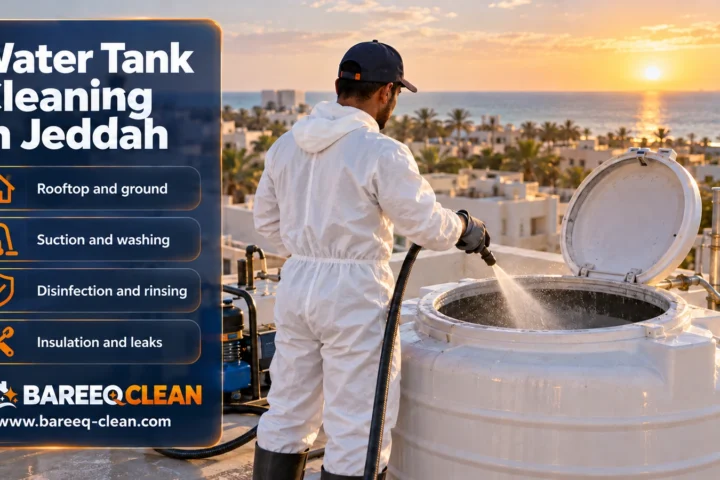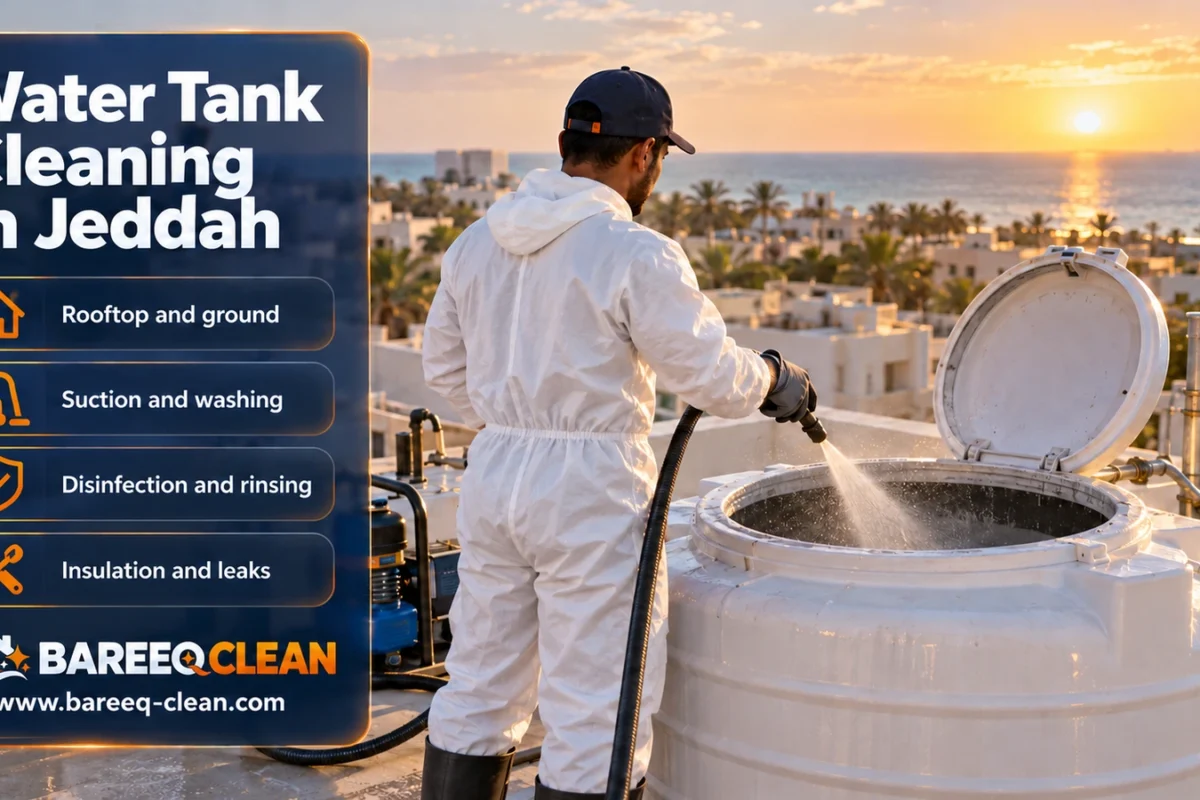
Bareeq Clean, a water tank cleaning company in Jeddah, washes and disinfects rooftop and ground tanks: emptying, sediment removal, washing of walls and floor, then disinfection and rinsing before refilling. Tank insulation, leak detection and repair are offered alongside. Rooftop tank cleaning starts from SAR 92 and ground tanks from SAR 208, with the tank handed back the same day.
Tank cleaning in Jeddah, in brief
- Rooftop tank: from SAR 92
- Ground tank, flat: from SAR 208
- Ground tank, villa: from SAR 325
- Ground and rooftop together, villa: from SAR 325
- Tank insulation: from SAR 1,110
- Time: 2 to 4 hours
- How often: Every 6 months
State the tank type, its size and the district, and get the price
Tank cleaning prices in Jeddah
Starting prices in riyals, set by the tank’s size, its type and the amount of sediment in it:
| Tank | Size | Starts from |
|---|---|---|
| Rooftop | Standard | SAR 92 |
| Ground, flat | Up to 7 tonnes | SAR 208 |
| Ground, villa | Up to 19 tonnes | SAR 325 |
| Large ground | Over 19 tonnes | SAR 460 |
| Concrete ground | By size | SAR 370 |
| Ground and rooftop together | Standard villa | SAR 325 |
| Buildings and mosques | Large | SAR 740 |
| Palaces and hotels | Very large | SAR 1,385 |
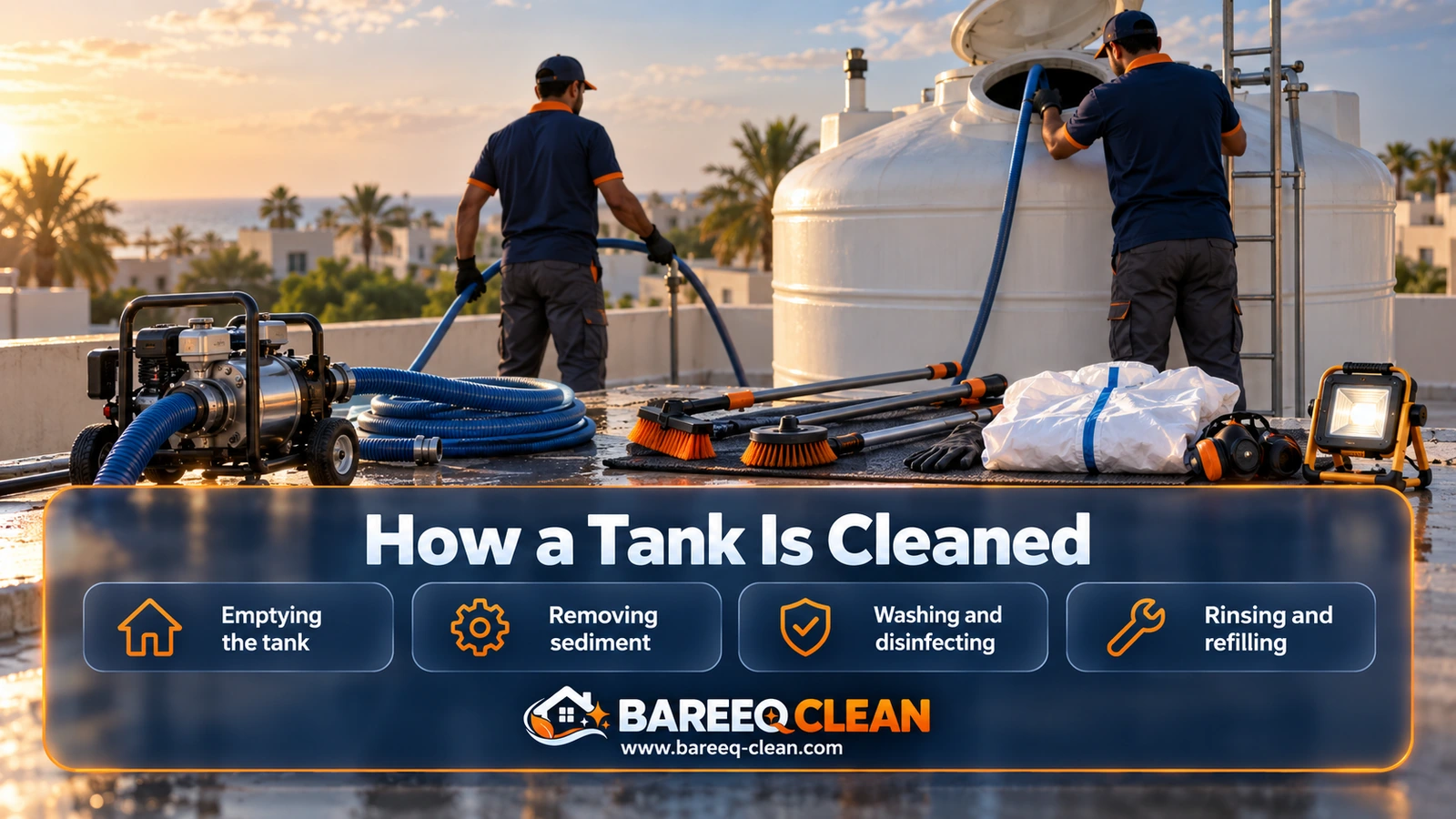
How a tank is cleaned
- Closing the valve and emptying: the water is pumped out, and part of it can be kept for non-drinking use.
- Removing sediment: mud, sand and rust collected on the floor.
- Washing walls and floor: with brushes and pressurised water, until algae and the slimy film are gone.
- Extracting the wash water: no dirty water is left in the tank.
- Disinfection: with a disinfectant made for drinking-water tanks, left for the time the product requires.
- Rinsing: with clean water until the smell of the disinfectant is gone.
- Check and refill: the float valve, lid and pipes are checked, then the valve is opened.
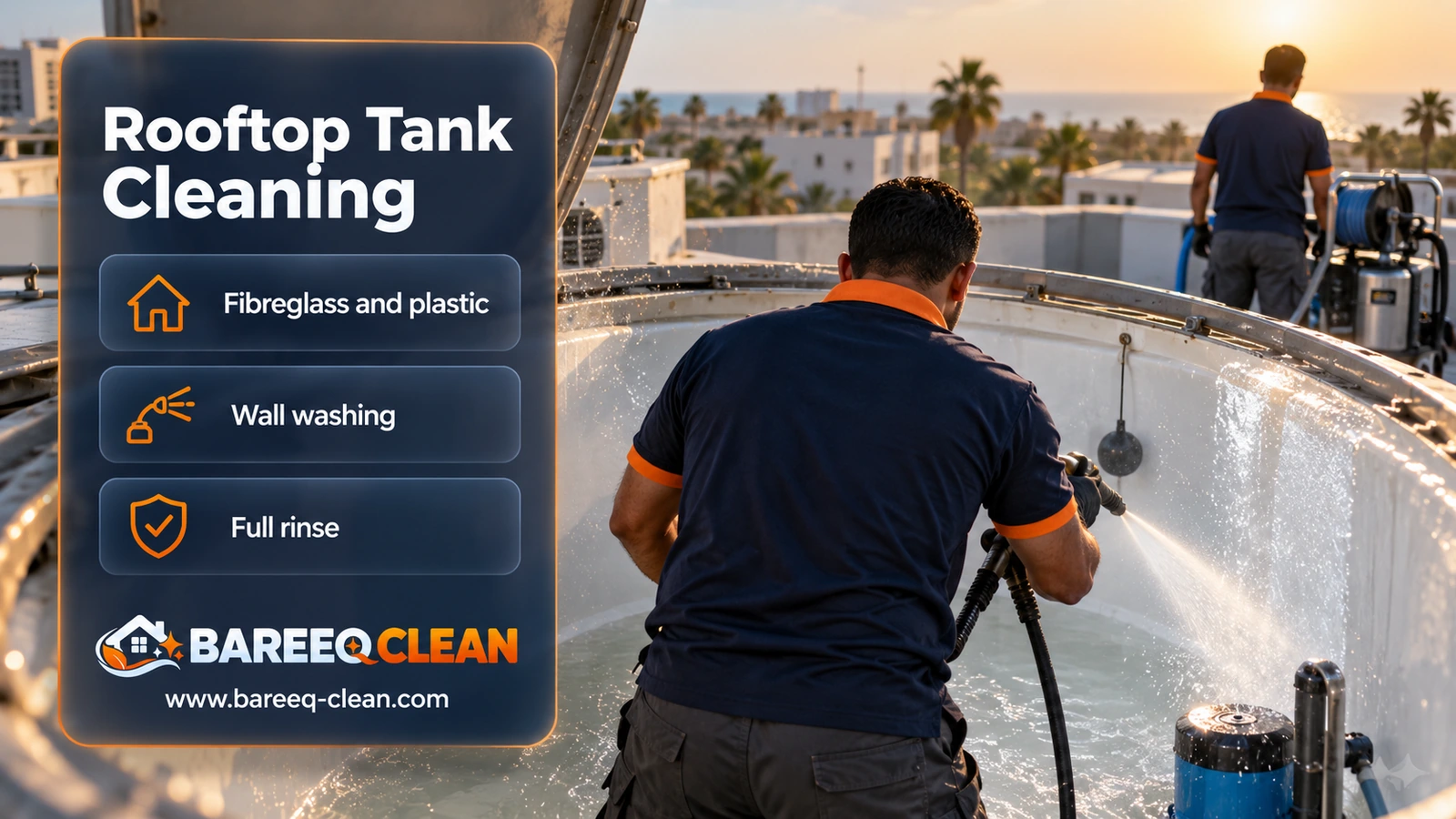
Rooftop tank cleaning in Jeddah
A rooftop tank sits in Jeddah’s direct sun, so its water warms and algae grow faster, especially if the lid is loose and lets in light and dust. It is easier to clean than a ground tank because it is smaller, and starts from SAR 92.
- Fibreglass: washed with soft brushes that do not scratch its surface.
- Plastic (polyethylene): checked for cracks and fading.
- Steel: rust is removed, and sealing or replacement is advised.
- Lid and float valve: checked, and the lid secured.
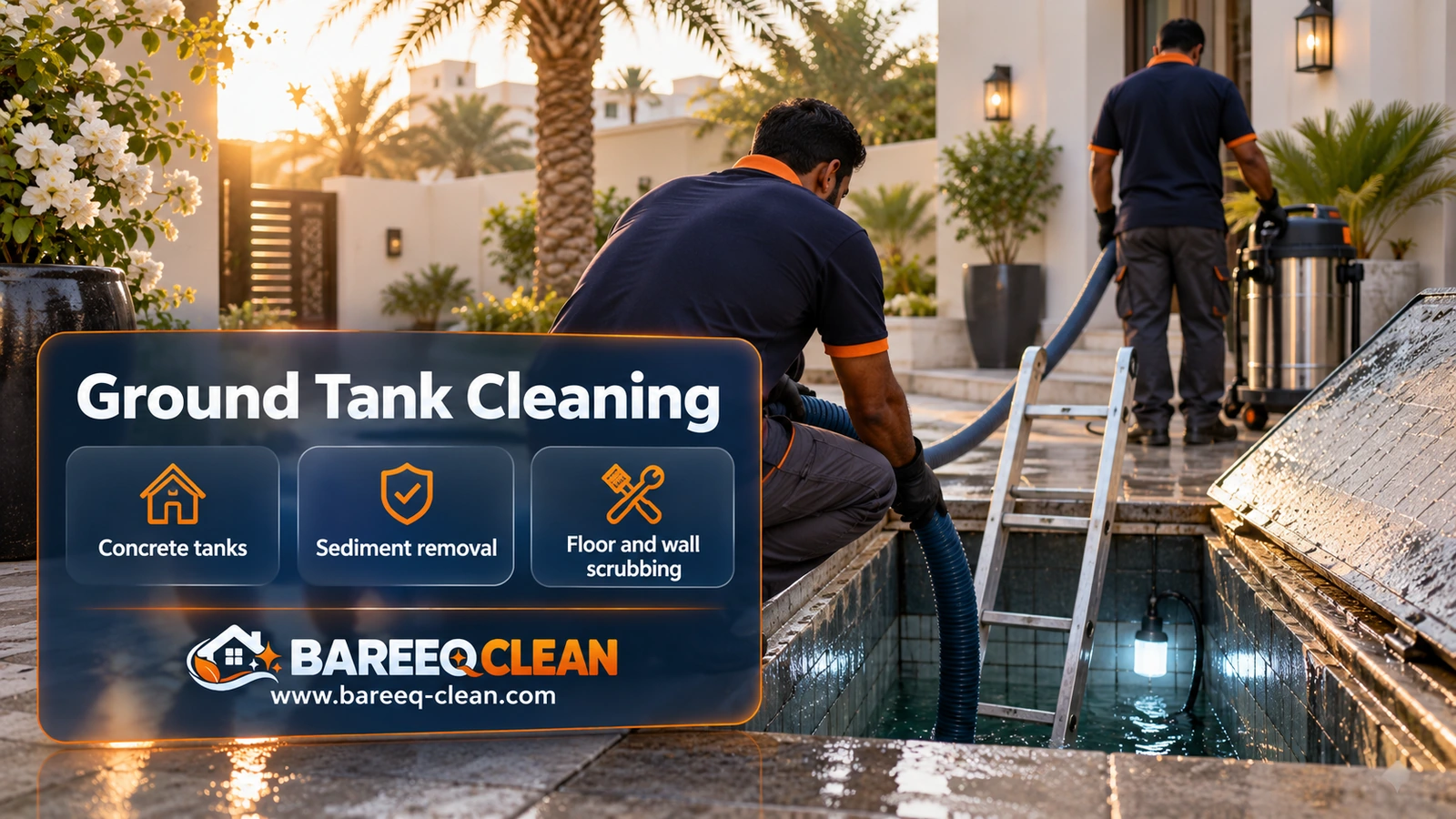
Ground tank cleaning in Jeddah
A ground tank is larger and deeper, and sediment from tanker and mains water builds up on its floor; if it cracks, water from around it can seep in. The technician goes down with confined-space equipment, and cleaning starts from SAR 208 for a flat’s tank and SAR 325 for a villa’s.
Water tank disinfection
Washing removes what can be seen, and disinfection deals with what cannot: bacteria and algae. A disinfectant made for drinking water is used at a concentration worked out for the tank’s size, and the tank is then well rinsed. The tank is not refilled before rinsing, and the first fill is not used for drinking if the smell of disinfectant remains.
Tank types and what suits each
| Type | What marks it out | What its cleaning needs |
|---|---|---|
| Concrete | Strong and large, but porous | Cracks checked, sealing where needed |
| Fibreglass | Light and rust-free | Soft brushes, hairline cracks checked |
| Multi-layer plastic | The most common on roofs | Lid and sun fading checked |
| Stainless steel | Does not react with water | A non-scratching cleaner without concentrated chlorine |
| Galvanised steel | Old and prone to rust | Rust removed, replacement advised |
Why do tanks in Jeddah get dirty faster?
- Heat: warm water is ideal for algae and bacteria.
- Tanker water: it carries sand and sediment that settle on the floor.
- Salts: they deposit on the walls as a limescale layer.
- Dust and humidity: they enter through any loose lid.
- High groundwater in some districts: it seeps into a cracked ground tank.
Signs your tank needs cleaning
How often should a tank be cleaned in Jeddah?
Every 6 months for household tanks. Jeddah’s heat and humidity speed up the growth of algae and bacteria, and tanker water carries more sediment. Rooftop tanks exposed to the sun and tanks filled by tanker need the shorter interval.
| Tank | How often |
|---|---|
| Rooftop, in the sun | Every 4 to 6 months |
| Household ground tank | Every 6 months |
| Buildings, mosques and schools | Every 3 to 6 months |
| Restaurants and hotels | Every 3 months |
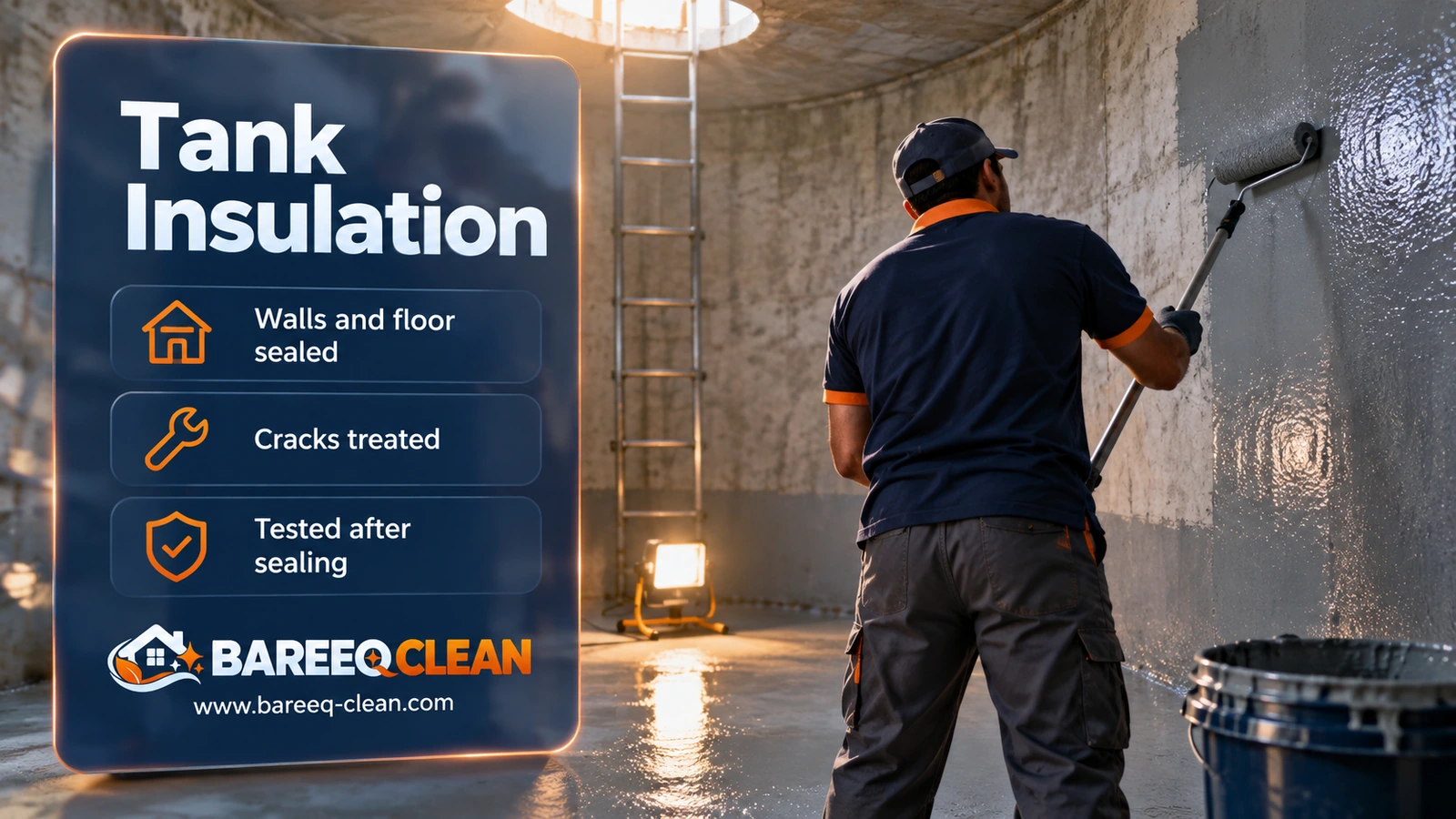
Tank insulation company in Jeddah
A concrete tank is porous, so water leaks out and salts and groundwater seep in. Insulation seals the pores and cracks with a layer that does not affect drinking water. The tank is cleaned, dried and its cracks treated before sealing, and left to cure before refilling.
| Type | What it suits | Starts from |
|---|---|---|
| Cementitious | Sound concrete tanks | SAR 1,110 |
| Epoxy | Higher protection and a smooth, easy-to-clean surface | SAR 1,665 |
| Combined | Old tanks or ones with many cracks | SAR 2,310 |
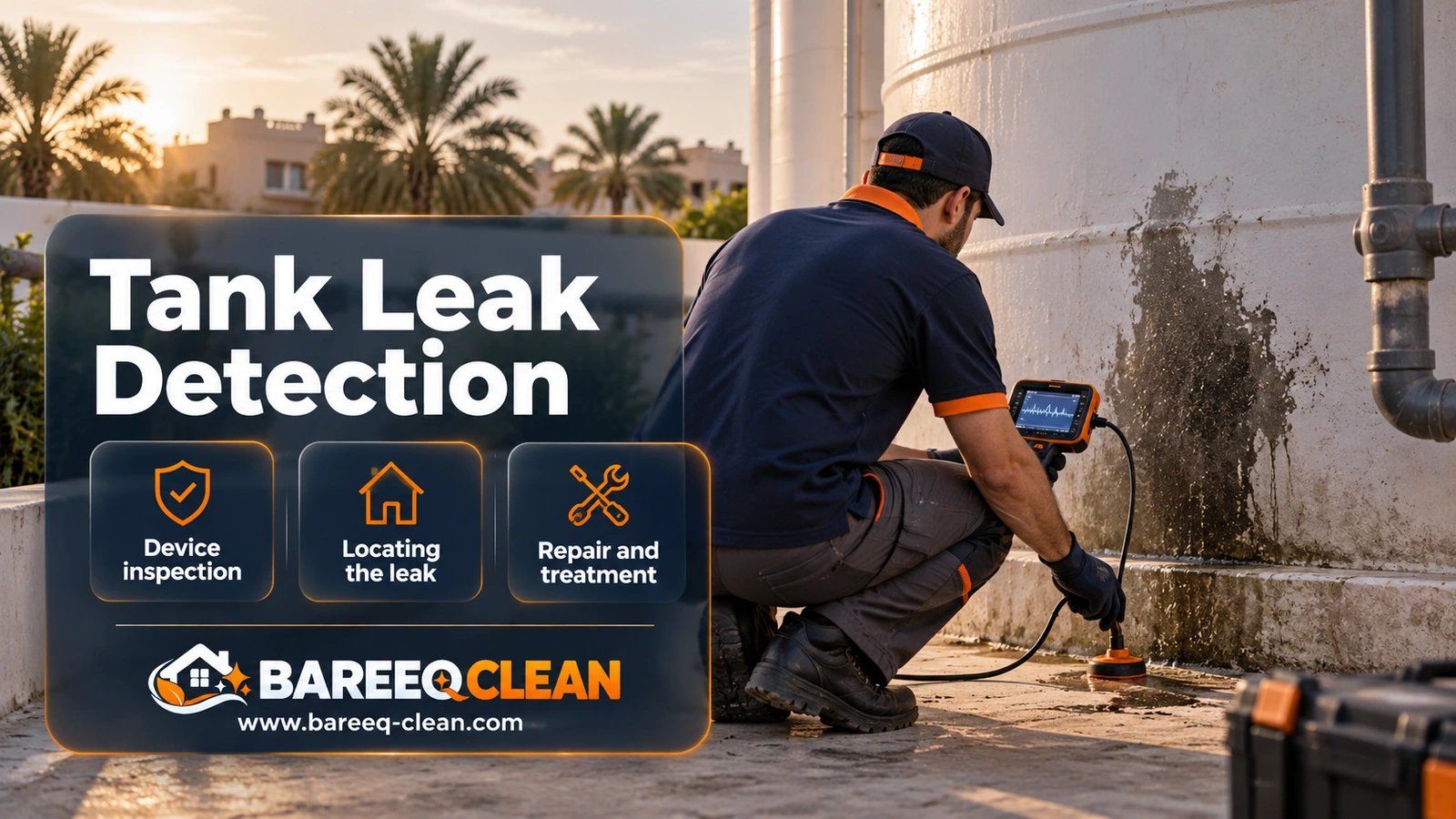
Tank leak detection and repair
- Signs of a leak: a high water bill, a tank that drops while shut, or damp around it.
- Detection: with devices that locate the spot without breaking anything.
- Repair: cracks injected and joints treated, then sealing.
- Testing after repair: the tank is filled and its level watched.
Cooling and heat-insulating a rooftop tank
Water in a rooftop tank in a Jeddah summer becomes too hot to shower with, and that same heat speeds algae growth. There are three remedies: a shade over the tank, an insulating jacket wrapped around it, or a sun-reflective coating. They are fitted after the tank is cleaned, and priced on request by its size and number.
Tank repair and maintenance
Tanks for buildings, mosques and hotels
Large tanks are cleaned at an agreed time so residents are not left without water for long, with a larger team and stronger pumps. They start from SAR 740 for buildings and mosques and SAR 1,385 for palaces and hotels, and a regular contract every 3 to 6 months suits them best.
Safety when working inside a tank
A ground tank is a confined space with little ventilation. A technician never goes down alone: a colleague stays at the hatch, the tank is aired before entry, and no product that gives off fumes is used inside. This is why owners are advised not to clean a ground tank themselves.
After cleaning: keeping the tank clean
- Secure the lid: light feeds algae, and an open hatch lets in dust and insects.
- Fit a filter on the water inlet.
- Ask where the tanker water comes from.
- Shade the rooftop tank or insulate it against heat.
- Write the cleaning date on the lid.
Common mistakes in tank cleaning
| Mistake | What it causes |
|---|---|
| Chlorine without measuring | Smell and taste in the water, and metal corrosion |
| Washing without removing sediment | Cloudiness returns with the first fill |
| Refilling without rinsing | Disinfectant residue in drinking water |
| Scented household cleaners | Foam and a smell that is hard to remove |
| Leaving the lid open afterwards | Contamination returns within days |
How to choose a tank cleaning company in Jeddah
- Do they remove sediment before washing?
- Which disinfectant is used? It must be made for drinking water.
- Does the technician enter a ground tank with a colleague at the hatch?
- Is the price known before the visit? By the tank’s size and type.
- Do they check the float valve, lid and cracks?
Before the team arrives
- Store enough water for the household for the hours of work.
- Switch off the pump before the team arrives.
- Clear the way to the tank hatch, and to the roof for a rooftop tank.
- State when the tank was last cleaned and any leak you have noticed.
Jeddah districts we serve
Every district of Jeddah: Obhur North and South, Al Hamdaniyah, Al Murjan, Ash Shati, An Naim, Al Mohammadiyah, Ar Rawdah, As Salamah, An Nahdah, Az Zahra, Al Khalidiyah, Al Andalus, Al Hamra, Al Faisaliyah, As Safa, Al Marwah, An Nuzhah, Al Aziziyah, Al Jamiah, As Sanabil, Al Ajaweed, An Nasim and As Samir, along with Rabigh, Khulais, Usfan and Al Lith. Other cleaning services are in cleaning company in Jeddah.
Book your tank cleaning in Jeddah
Article tags
Tanks: water tank cleaning Jeddah · tank disinfection Jeddah · rooftop tank cleaning · ground tank cleaning · tank insulation Jeddah · tank leak detection Jeddah · tank cleaning prices Jeddah
Frequently asked questions about tank cleaning in Jeddah
How much does tank cleaning cost in Jeddah?
From SAR 92 for a rooftop tank and SAR 208 for a ground tank with Bareeq Clean.
How much does a villa tank cost to clean?
From SAR 325 for a ground tank of up to 19 tonnes, and from SAR 325 for ground and rooftop together.
How much does tank insulation cost?
From SAR 1,110 for cementitious sealing and SAR 1,665 for epoxy.
How often should a tank be cleaned?
Every 6 months, or every 4 for a rooftop tank in the sun.
How long does tank cleaning take?
2 to 4 hours depending on size, handed back the same day.
Is the water cut during cleaning?
Yes, only for the duration of the work. Keep enough water for a few hours.
Is the disinfectant safe for drinking water?
A disinfectant made for drinking-water tanks is used, and the tank is rinsed afterwards.
When can I use the water after cleaning?
As soon as the tank has been rinsed and refilled.
What are the signs of a tank leak?
A higher bill, the level dropping while the tank is shut, and damp around it.
What is the difference between cementitious and epoxy sealing?
Cementitious is cheaper and suits a sound tank; epoxy is tougher with a smooth surface.
Do you clean tanks for buildings and mosques?
Yes, from SAR 740, and on regular contracts.
Can I clean the tank myself?
A small rooftop tank, with care. A ground tank is not advised, as it is a confined space with little ventilation.
How do I cool the water in a rooftop tank?
With a shade over it, an insulating jacket around it or a sun-reflective coating.
Do you repair fibreglass tanks?
Yes, by patching cracks with layers of fibre and resin.
What is the cheapest tank cleaning in Jeddah?
SAR 92 for a rooftop tank with Bareeq Clean, against a lowest published market price of SAR 100.
Do you serve every district of Jeddah?
Yes, along with Rabigh, Khulais, Usfan and Al Lith.