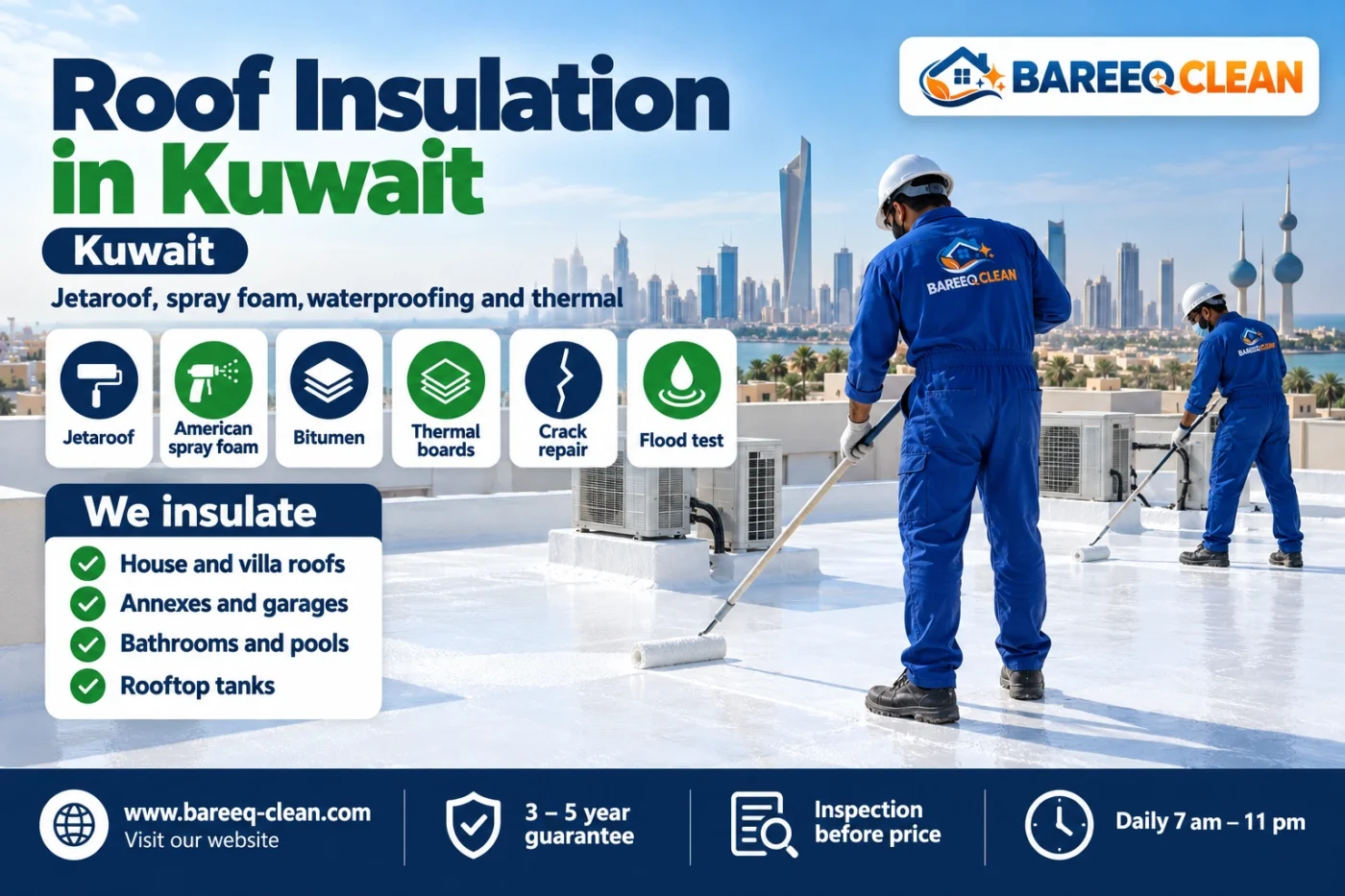
Roof insulation in Kuwait by Bareeq Clean: waterproofing and thermal insulation for the roofs of houses, villas, annexes and garages using Jetaroof, American spray foam (polyurethane), bitumen rolls and thermal boards, with crack and gutter repair and a flood test before handover. Bitumen starts from KWD 2.5 per m², spray foam from KWD 3.5 and Jetaroof from KWD 4.5, across all governorates of Kuwait, with a 3 to 5-year guarantee.
Roof insulation in Kuwait, in brief
- Types: Jetaroof, American spray foam, bitumen, thermal boards, combined system
- Bitumen waterproofing: from KWD 2.5 per m²
- Thermal boards: from KWD 3 per m²
- American spray foam: from KWD 3.5 per m²
- Jetaroof: from KWD 4.5 per m²
- Combined system (water + heat): from KWD 5 per m²
- Duration: 1 to 3 days, then a 24 – 48 hour flood test
- Guarantee: 3 years on Jetaroof and bitumen, 5 years on foam and combined systems
- Coverage: all six governorates
- Working hours: daily, 7 am to 11 pm
Send us the roof area in square metres, whether it is tiled, the problem (leaks or heat) and your area in Kuwait
Article Map23 sections · jump straight to what you need
- 1Why does a house roof in Kuwait need insulation?
- 2Signs your roof needs insulation
- 3Waterproofing, thermal insulation or both?
- 4Jetaroof roof waterproofing in Kuwait
- 5American spray foam insulation in Kuwait (polyurethane)
- 6Thermal insulation with boards, rock wool and foam concrete
- 7Bitumen waterproofing (rolls and torch-on membranes)
- 8Polyethylene sheeting and membranes
- 9Roof insulation steps, from inspection to flood test
- 10Insulating garages, annexes and Kirby and Shinko roofs
- 11Thermal insulation for rooftop water tanks
- 12Waterproofing bathrooms, kitchens and pools
- 13Clear waterproofing over tiles and ceramics
- 14Roof insulation prices in Kuwait
- 15Cheapest ways to insulate a roof
- 16Best roof insulation in Kuwait
- 17How long does insulation last, and how do you look after it?
- 18Common roof insulation mistakes
- 19How to choose a roof insulation company in Kuwait
- 20Areas we serve in Kuwait
- 21Service guarantee
- 22Article tags
- 23Frequently asked questions about roof insulation in Kuwait
Why does a house roof in Kuwait need insulation?
A roof in Kuwait faces the two harshest conditions in the Gulf: summer heat above fifty degrees in the shade, which pushes the temperature of exposed concrete far higher, followed by winter rain that falls on few days but heavily and suddenly. Concrete expands by day and contracts at night, opening hairline cracks that widen year after year. Rainwater seeps through them into the slab and the steel reinforcement, which rusts, swells and breaks the concrete around it.
On the thermal side, an uninsulated roof stores the day’s heat and releases it into upper-floor rooms until midnight, so the air conditioning runs longer and the bill rises. That is why Kuwait’s energy conservation code for buildings, issued by the Ministry of Electricity and Water, sets a stricter maximum for heat transfer through roofs than through walls: the roof receives more sun than any other part of the house.
This table summarises what happens to an uninsulated roof in Kuwait:
| Condition | What happens to the roof | Result inside the home |
|---|---|---|
| Direct summer sun | Concrete stores heat for hours | Hot upper floor and non-stop AC |
| Day–night temperature swing | Expansion and contraction open hairline cracks | Water paths that widen every year |
| Sudden winter rain | Water pools around gutters and corners | Yellow stains and peeling ceiling paint |
| Water reaching the rebar | Rust swells and cracks the concrete | Flakes falling from the ceiling, structural weakness |
| Dust and storms | Build-up blocks the gutters | Water stays on the roof longer |
| Leaks from rooftop tanks | Constant water at one spot | Persistent damp in one room’s ceiling |
Signs your roof needs insulation
Waterproofing, thermal insulation or both?
Choosing insulation starts with the problem, not the product name. If the roof leaks in winter you need waterproofing; if the upper floor is hot in summer you need thermal insulation; if you have both, the answer is a combined system or a material that does both jobs, such as spray foam. The table shows the difference:
| Insulation type | What it solves | Common materials | Suits |
|---|---|---|---|
| Waterproofing | Rain and tank leaks | Jetaroof, bitumen, polyethylene membranes | A leaking roof with tolerable heat |
| Thermal insulation | Upper-floor heat | Polystyrene boards, rock wool, foam concrete | A roof that does not leak but hot rooms |
| Both in one material | Leaks and heat together | American spray foam with a protective coat | Most villa and annex roofs |
| Multi-layer combined system | Leaks and heat with maximum protection | Membrane + thermal boards + protection layer | New builds and full renovations |
Jetaroof roof waterproofing in Kuwait
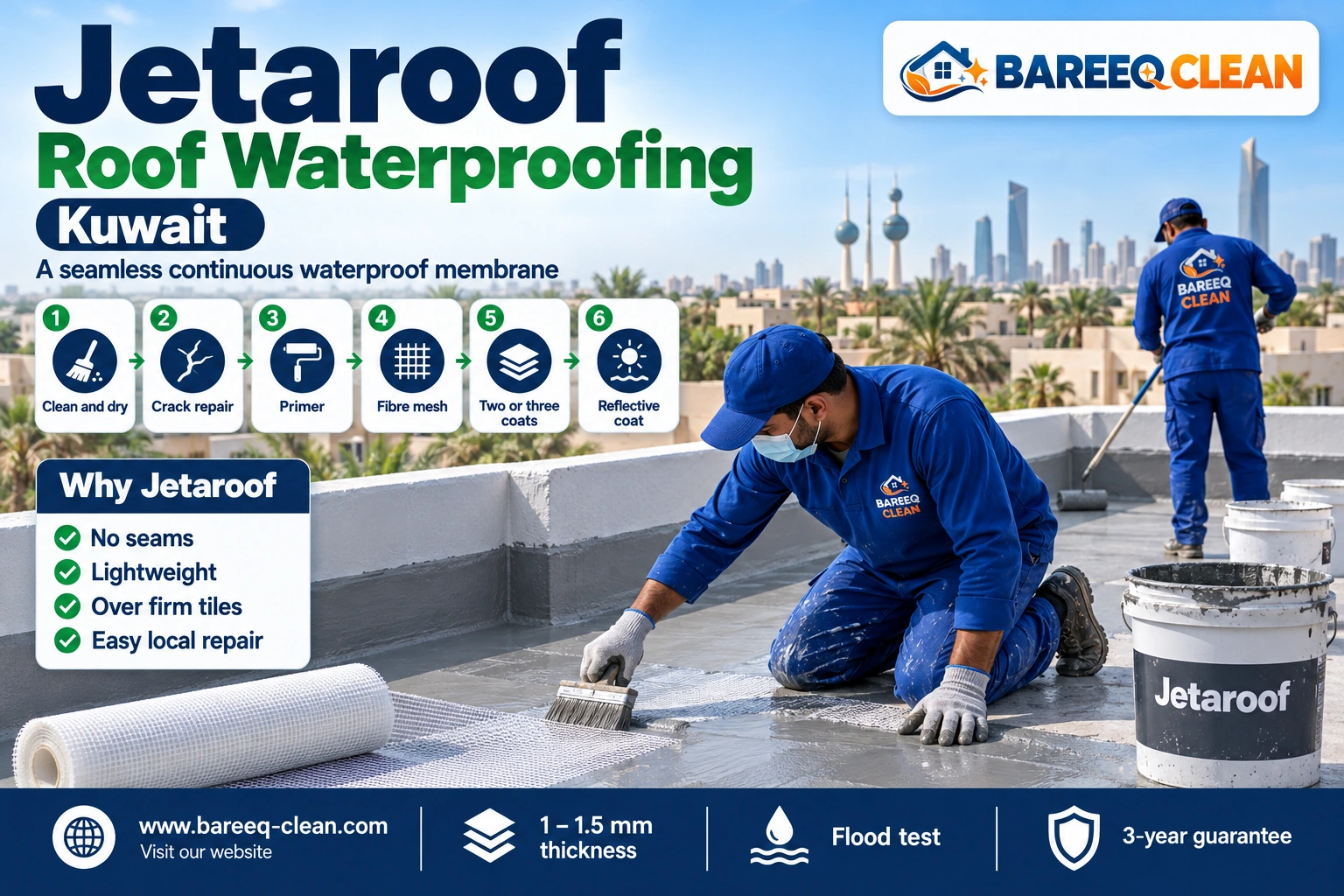
Jetaroof waterproofing in Kuwait starts from KWD 4.5 per m². Jetaroof is a liquid waterproofing material based on flexible acrylic. It is brushed onto the roof in layers over a fibreglass mesh and cures into a single continuous membrane with no joints or seams. Its flexibility lets it expand and contract with the concrete through hot days and cool nights without cracking, and its white or silver top coat reflects much of the sun’s rays.
What a homeowner should know is that Jetaroof is essentially waterproofing: it stops leaks and its reflective colour eases roof temperature, but it does not give the thermal insulation that boards or foam of sufficient thickness provide. If your complaint is hot rooms rather than leaks, Jetaroof alone will not solve it.
Jetaroof pros and cons
| Pros | Cons |
|---|---|
| A continuous membrane with no seams to leak | Limited thermal insulation compared with foam and boards |
| Lightweight, adds no load to the slab | The reflective coat must be renewed as it fades |
| Applied over firm tiles without breaking them | Does not tolerate heavy foot traffic or direct loads |
| Easy to repair with a local coat | Fails if applied on a damp or dirty surface |
| Wraps around gutters, pipes and corners | Quality depends on thickness and number of coats |
How Jetaroof is applied
- Cleaning: removing dust, dirt and old flaking insulation, washing the roof and letting it dry.
- Crack repair: opening and filling cracks with a flexible filler, and forming a fillet where the roof meets the walls.
- Around gutters and pipes: extra reinforcement, as these are the most common leak points.
- Primer: a base coat that opens the pores and secures adhesion.
- First coat and fibre mesh: the mesh is laid into the first coat while still wet so it is fully embedded.
- Second and third coats: applied crosswise once the first has dried, to a thickness of at least 1 – 1.5 mm.
- Reflective coat: white or silver to reflect the sun and protect the membrane.
- Flood test: blocking the gutters, filling the roof with water and checking the ceiling below.
Jetaroof price in Kuwait
Jetaroof in Kuwait starts from KWD 4.5 per m², rising if old insulation must be removed, many cracks treated or a third coat added. Jetaroof products on the market vary between local and imported, so ask for the product name, its specifications, the number of coats and the final thickness, not just the trade name.
American spray foam insulation in Kuwait (polyurethane)
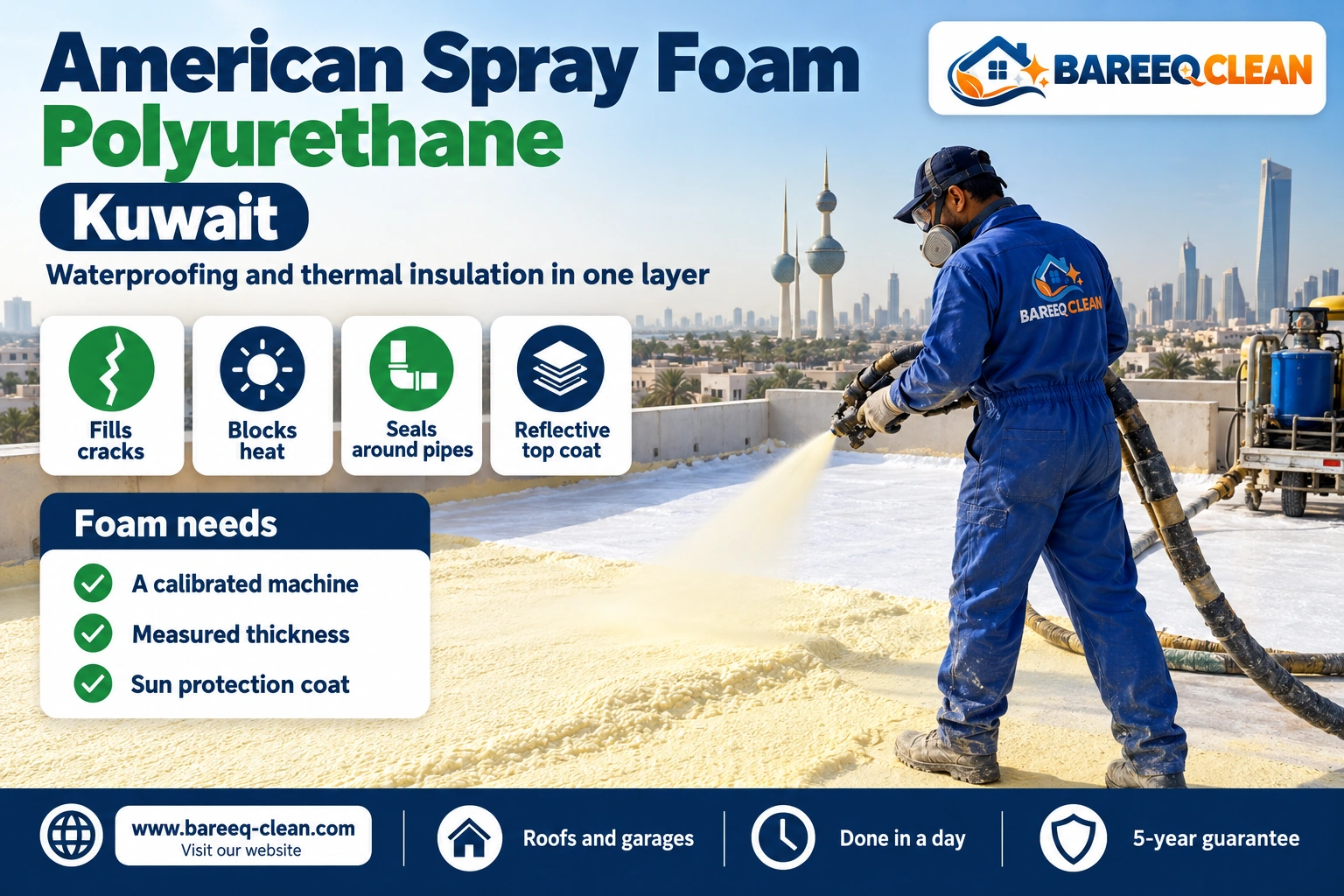
American spray foam insulation in Kuwait starts from KWD 3.5 per m². It is polyurethane foam sprayed with a dedicated machine from two liquids that mix at the gun nozzle, expand within seconds and harden into a firm foam layer bonded to the roof. Its advantage is that it combines thermal insulation, because its closed cells are filled with gas, with waterproofing, because it forms one continuous layer that fills cracks and gaps around every pipe and base.
But foam cannot take direct sunlight: left exposed, it discolours and its surface erodes within months. So spray foam is only complete with a protective layer on top, either a flexible sun-reflective coating, or a cement screed or tiles if the roof is walked on.
What spray foam is made of
Insulating foam is made of two components, polyol and isocyanate, pumped together at a set ratio and temperature. If the ratio is off or the machine is not calibrated, the result is brittle or sticky foam that does not insulate properly, which is why the same material performs differently in different hands. Foam is specified by density and thickness, both set according to what the roof needs, and the thickness is measured at several points after spraying.
Spray foam or insulation boards?
Boards give a uniform, known thickness but need a waterproof membrane below and a protection layer above. Foam bonds to the roof as it is and covers irregular and metal surfaces, but needs a skilled applicator and a protective coat. On roofs crowded with pipes, plinths and AC units, foam is easier and seals more tightly.
Thermal insulation with boards, rock wool and foam concrete
Thermal board insulation in Kuwait starts from KWD 3 per m². These materials do not stop water on their own; they sit above or below a waterproof membrane depending on the system, and their job is to slow heat transfer from the roof into the ceiling. The table lists the most common:
| Material | Form | Where it is used | Note |
|---|---|---|---|
| Extruded polystyrene | Rigid boards that do not absorb water | Over the membrane, under the protection layer | The most common on roofs |
| Expanded polystyrene | Lighter, cheaper boards | Under a protection layer | Absorbs more moisture than extruded |
| Rock wool | Fibre boards or rolls | Metal roofs and walls | Withstands high temperatures |
| Glass wool | Light rolls | Under Kirby sheets and in stores | Needs a cover against moisture |
| Foam concrete | Light cellular concrete, poured | Screed-to-falls and insulation over the slab | Sets the roof slope towards the gutters |
| Perlite | Light granules mixed with cement | Insulating and sloping layer | A lightweight alternative to sand |
Bitumen waterproofing (rolls and torch-on membranes)
Bitumen waterproofing in Kuwait starts from KWD 2.5 per m², the cheapest and oldest waterproofing method. Modified bitumen rolls are laid on the roof after a primer coat and torched to the surface and to each other with an overlap of at least ten centimetres, then turned up the side walls so water cannot enter at the corner. Cold-applied bitumen is brushed on in small areas and bathrooms.
Bitumen is not normally left exposed to the sun; a protective screed of light concrete or tiles is laid over it, which raises the total cost and the weight on the roof. Any hole made in the roof after insulation, to fix a shade or an AC base, becomes a leak point unless it is treated properly.
Bitumen or Jetaroof?
| Comparison | Bitumen rolls | Jetaroof |
|---|---|---|
| From | KWD 2.5 per m² | KWD 4.5 per m² |
| Joints | Seams between rolls | A single seamless membrane |
| Weight | Heavier, needs a protection layer | Very light |
| Left exposed | Not usually | Yes, with its reflective coat |
| Repair | Requires lifting the protection layer | A local coat |
| Best for | New builds before tiling | Renovating existing roofs and leaks |
Polyethylene sheeting and membranes
Black polyethylene sheeting is a cheap flexible layer laid under concrete or tiles to stop moisture moving up or down. It is a useful supporting layer in new builds, but it is not relied on alone to waterproof an existing leaking roof. Modern multi-layer membranes are used in combined systems beneath the thermal boards.
Tell us the roof area and the problem, and send photos of the ceiling from inside and your area in Kuwait

Roof insulation steps, from inspection to flood test
Whatever the material, half the quality of insulation lies in the preparation. A clean, dry roof with treated cracks will hold any product for years, while the most expensive product sprayed on a dirty roof peels in the first summer. These are our steps on every roof:
- Inspection and measuring: measuring the area, checking falls and gutters, and viewing the ceiling from inside to locate leaks.
- Removal where needed: old flaking insulation, hollow tiles and debris.
- Cleaning and drying: pressure washing, then letting the roof dry completely.
- Correcting falls: treating spots where water pools so it reaches the gutter.
- Cracks and corners: filling cracks and forming a sloped fillet between roof and wall.
- Gutters and pipes: reinforcing around them with flexible material and mesh.
- Applying the insulation: in the layers and thickness the material requires.
- Protection layer: reflective coat, cement screed or tiles depending on the system.
- Flood test and handover: filling the roof with water and monitoring it, then handing over with maintenance guidance.
The flood test
The flood test is the proof that the insulation works: the gutters are temporarily blocked, the roof is filled with a few centimetres of water and left for 24 to 48 hours while the ceiling is watched from inside. If damp appears anywhere, it is fixed before handover, not after the first rain. Ask any insulation company for this test; a refusal is a bad sign.
Insulating garages, annexes and Kirby and Shinko roofs

Garage and annex insulation in Kuwait starts from KWD 3.5 per m². Metal roofs made of Kirby and Shinko sheets heat up in summer until the garage or annex beneath is unbearable, and in winter condensation forms on their underside and drips. Spraying polyurethane foam on the sheets, from above or inside, solves both problems and seals the screws and joints rain gets through, followed by a protective coat if exposed.
- Garages: foam on the metal roof lowers the heat on the cars and the space.
- Annexes and outdoor rooms: foam or wool boards under the sheets with a false ceiling.
- Shades and seating areas: light foam reduces heat and the noise of rain.
- Stores: rock wool or foam to protect goods from heat.
Thermal insulation for rooftop water tanks
A rooftop tank’s water heats up in summer until showering becomes difficult. Insulating it with an insulating cover or a layer of foam around the tank, together with shading, eases that heat, and it is usually done during the same visit as the roof. If you want genuinely cool water, the answer is a cooling unit or fan; you will find the comparison in water tank cooling in Kuwait, and lining and cleaning ground tanks in water tank cleaning in Kuwait.
Waterproofing bathrooms, kitchens and pools
Water from an upper-floor bathroom leaking into the ceiling below is one of the most common problems in older Kuwaiti homes. The fix is waterproofing the bathroom floor with a flexible membrane (cementitious or cold bitumen) turned up the walls, before re-tiling. Pools need waterproofing that withstands constant water pressure and pool chemicals, tested by filling before tiling. Bathroom and pool waterproofing is priced after inspection, as it depends on removing existing tiles and the wall area.
Clear waterproofing over tiles and ceramics
A clear waterproof sealer is applied over tiles and ceramics without removing them; it penetrates the joints and pores and closes them, leaving the tiles looking the same. It suits balconies, terraces and tiled roofs with minor leaks through the joints. But it does not treat cracks in the concrete beneath, nor hollow tiles, and it needs recoating every few years. After inspection we tell you plainly whether a clear sealer is enough or your roof needs full insulation.
Roof insulation prices in Kuwait
These are starting prices in Kuwaiti dinars per square metre. The price covers materials, application and the flood test; the final figure is set after inspection.
| Insulation type | From (per m²) | Duration | Guarantee |
|---|---|---|---|
| Bitumen roll waterproofing | KWD 2.5 | 1 – 2 days | 3 years |
| Thermal insulation boards | KWD 3 | 2 – 3 days | 3 years |
| American polyurethane spray foam | KWD 3.5 | 1 day | 5 years |
| Jetaroof | KWD 4.5 | 1 – 2 days | 3 years |
| Combined system (water + heat) | KWD 5 | 3 – 5 days | 5 years |
| Garages and annexes (foam) | KWD 3.5 | 1 day | 5 years |
| Bathrooms and pools | Priced after inspection | Depends on area | 3 years |
What raises or lowers the price?
- Area: larger roofs get a lower price per m².
- Roof condition: removing old insulation or hollow tiles adds cost.
- Cracks and falls: treating them is essential, not optional.
- Thickness and number of coats: the main thing that separates two quotes at the same price.
- Protection layer: a reflective coat is cheaper than a screed or tiles.
- Roof access: lifting materials to high floors needs equipment.
How much does it cost to insulate a 200 m² villa roof?
A 200 m² villa roof starts from about KWD 900 with Jetaroof, about KWD 700 with spray foam and about KWD 500 with bitumen rolls before the protection layer. This is a calculation at the starting price per m²; the actual price becomes clear once the roof’s condition is known.
Cheapest ways to insulate a roof
The cheapest way to insulate a roof in Kuwait is bitumen rolls from KWD 2.5 per m², followed by spray foam from KWD 3.5. But cheapest on the day is not always cheapest over the years: bitumen needs a protection layer that adds cost and weight, and cheap insulation applied too thin is redone after a winter or two. The right calculation is the price per m² divided by the years of guarantee.
Best roof insulation in Kuwait
The best roof insulation in Kuwait is the one that fits your roof’s problem. This table helps you choose:
| Roof condition | Suggested insulation | Why |
|---|---|---|
| Existing leaking roof with firm tiles | Jetaroof | Applied over tiles without breaking them |
| Hot upper floor and a leaking roof | Spray foam with reflective coat | Combines waterproofing and thermal insulation |
| New build before tiling | Combined system: membrane + boards + protection | Highest protection and longest life |
| Tight budget, untiled roof | Bitumen rolls with protection | Lowest price per m² |
| Metal roof on a garage or annex | Polyurethane foam | Bonds to the sheets and seals the joints |
| Minor leaks through tile joints | Clear sealer | Keeps the tiles’ appearance |
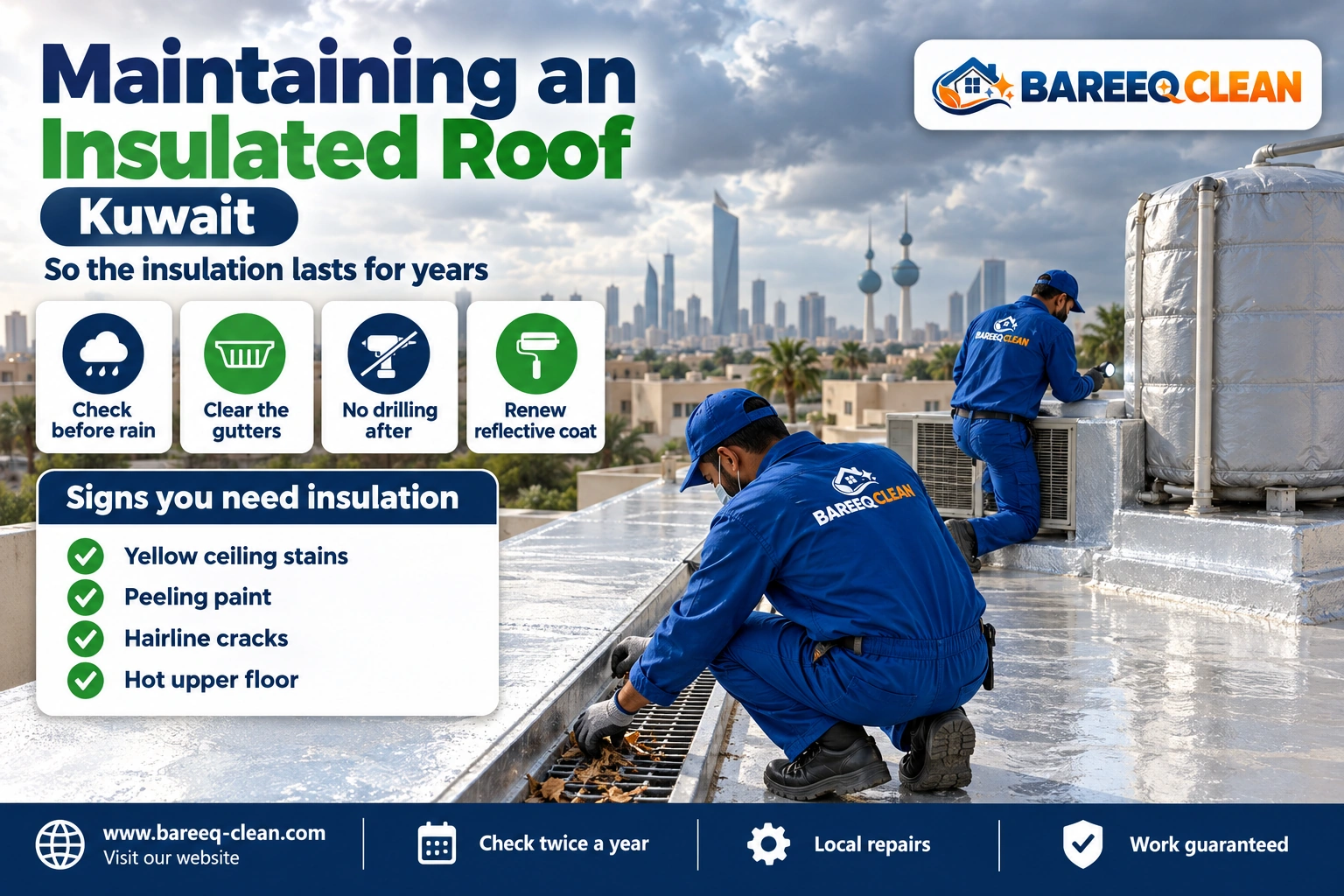
How long does insulation last, and how do you look after it?
The life of insulation depends on three things: the thickness it was applied at, the protection layer above it, and what happens to the roof afterwards. Well-applied insulation serves for many years, and loses half its life if gutters are left clogged with dust or AC bases and shades are screwed through it untreated. The reflective coat on Jetaroof or foam is renewed whenever it fades, usually every two to three years under Kuwait’s sun.
- Check the roof twice a year: before the rains and after the summer.
- Clean the gutters: of dust and storm debris before winter.
- Do not drill the roof after insulation: and if you must, have the hole sealed with the same material.
- Do not place loads directly: on Jetaroof or foam without wide bases.
- Renew the reflective coat: when it fades or flakes.
- Watch the ceiling from inside: check any new stain before it grows.
Common roof insulation mistakes
| Mistake | What it causes |
|---|---|
| Insulating over a damp or dusty roof | The insulation peels in the first summer |
| Ignoring corners and gutters | Leaks from the weakest points despite insulation |
| A single thin coat of Jetaroof | Cracks with the first concrete movement |
| Leaving foam without a protective coat | Surface erosion and discolouration within months |
| Not correcting the falls | Water pools and stresses the insulation |
| Handover without a flood test | The leak is found with the first rain |
How to choose a roof insulation company in Kuwait
- Do they inspect before pricing? A price over the phone without seeing the roof is a guess.
- Do they specify material, thickness and number of coats? This is how you compare quotes.
- Do they treat cracks, gutters and corners? Or just spray over them.
- Do they do a flood test before handover? The clearest proof of the work.
- Is the guarantee written with a realistic period? Twenty-year promises with no detail are worthless.
Areas we serve in Kuwait
We insulate roofs in all six governorates of Kuwait, scheduling inspection and work by area and weather: we never insulate on a day of rain or a dust storm. Main areas by governorate:
| Governorate | Main areas |
|---|---|
| Capital | Shuwaikh, Dasma, Daiya, Qadsiya, Mansouriya, Kaifan, Rawda, Adailiya, Khaldiya, Yarmouk, Qurtuba, Surra, Faiha, Nuzha, Shamiya |
| Hawalli | Hawalli, Salmiya, Jabriya, Rumaithiya, Bayan, Mishref, Salwa, Shaab, Zahra, Salam, Hateen, Siddiq, Shuhada |
| Farwaniya | Farwaniya, Khaitan, Ardiya, Andalus, Rabia, Rehab, Ishbiliya, Omariya, Firdous, Sabah Al-Nasser, Abdullah Al-Mubarak |
| Ahmadi | Ahmadi, Fahaheel, Mangaf, Fintas, Mahboula, Abu Halifa, Riqqa, Hadiya, Sabahiya, Egaila, Jaber Al-Ali, Fahad Al-Ahmad, Sabah Al-Ahmad, Khiran |
| Jahra | Jahra, Saad Al-Abdullah, Qasr, Naseem, Waha, Taima, Oyoun, Naeem, Mutlaa |
| Mubarak Al-Kabeer | Sabah Al-Salem, Qurain, Adan, Qusour, Messila, Abu Ftaira, Fnaitees, Mubarak Al-Kabeer, Abu Al-Hasaniya |
Roof insulation in Hawalli, Mishref and Bayan
Hawalli, Mishref, Bayan and Salwa have many older villas with tiled roofs that leak at corners and gutters; we usually treat them with Jetaroof over firm tiles after repairing the joints.
Roof insulation in Jahra, Mutlaa and Saad Al-Abdullah
Mutlaa, Saad Al-Abdullah and south Jahra have many new homes, the best moment for a combined system before tiling, while annexes and garages get spray foam on their metal roofs.
Roof insulation in Ahmadi, Sabah Al-Ahmad and Khiran
In Ahmadi, Fahaheel, Sabah Al-Ahmad City and the seaside chalets of Khiran, heat combines with sea humidity, and there we prefer spray foam with a durable reflective coat.
Roof insulation in Farwaniya, Mubarak Al-Kabeer and the Capital
In Farwaniya and Abdullah Al-Mubarak, in Sabah Al-Salem, Qurain and Adan, and in Capital areas such as Rawda, Yarmouk and Shamiya, most requests are for existing villa roofs and upper annexes, and we choose the material after viewing the ceiling from inside.
Service guarantee
We guarantee Jetaroof, bitumen and thermal board insulation for 3 years, and spray foam and combined systems for 5 years, repairing free of charge any leak that appears from the insulated area within that period, unless the roof is drilled or altered after handover. Details are on our service guarantee page. If the leak comes from the rooftop tank rather than the roof, see water tank repair in Kuwait.
Send us the roof area, photos of the roof and the ceiling from inside and your area in Kuwait, and we will send the price and an inspection time
Article tags
Roof insulation: roof insulation Kuwait · roof insulation company Kuwait · best roof insulation Kuwait · cheap roof insulation Kuwait · roof insulation price per m2 Kuwait · roof waterproofing Kuwait · thermal roof insulation Kuwait · rain leak roof repair Kuwait
Materials: Jetaroof Kuwait · Jetaroof price · American spray foam Kuwait · polyurethane foam roof · bitumen waterproofing Kuwait · foam concrete roof · clear sealer over tiles · Kirby roof insulation · rooftop tank insulation
Areas: roof insulation Hawalli · roof insulation Jahra · roof insulation Ahmadi · roof insulation Farwaniya · roof insulation Mubarak Al-Kabeer · roof insulation Mutlaa · roof insulation Sabah Al-Ahmad
Frequently asked questions about roof insulation in Kuwait
How much does roof insulation cost per square metre in Kuwait?
Bitumen waterproofing starts from KWD 2.5 per m², thermal boards from KWD 3, spray foam from KWD 3.5, Jetaroof from KWD 4.5 and a combined system from KWD 5.
How much is Jetaroof in Kuwait?
Jetaroof starts from KWD 4.5 per m², including roof cleaning, crack repair, fibre mesh and the reflective top coat.
What is the best roof insulation in Kuwait?
No single product is best for every roof: spray foam combines waterproofing and thermal insulation, Jetaroof suits leaks on a sound roof, and a combined system suits homes with both heat and leak problems.
Is Jetaroof a thermal insulator?
It is mainly a waterproofing coating. Its white reflective finish lowers roof temperature, but it does not replace thermal insulation if the problem is a hot upper floor.
Which is better: bitumen or Jetaroof?
Bitumen is cheaper but needs a protective layer on top; Jetaroof has no seams, is easier to repair and stays exposed. We choose based on the roof’s condition and what sits on it.
How long does roof insulation take?
One to three days for a typical house roof, plus a 24 to 48-hour flood test.
Can the roof be insulated over existing tiles?
Yes with Jetaroof or spray foam, if the tiles are firm and not hollow, after cleaning and treating the joints. Broken or hollow tiles are removed first.
How long does roof insulation last?
Many years when applied at the right thickness and when the reflective coat is renewed as it fades. It lasts less if gutters are left blocked or the roof is drilled after insulation.
Is the insulation guaranteed?
Yes: 3 years on Jetaroof and bitumen, and 5 years on spray foam and combined systems, with any leak repaired within that period.
Do you insulate garages and annexes with metal roofs?
Yes, by spraying polyurethane foam onto Kirby and Shinko sheets, starting from KWD 3.5 per m².
What is the cheapest way to insulate a roof?
Bitumen rolls from KWD 2.5 per m², but they need a protective layer and can cost more in the long run if they do not suit your roof.
Do you insulate rooftop water tanks?
Yes, with an insulating cover or sprayed insulation around the tank; we cover this alongside cooling options in our water tank cooling article.
Does roof insulation lower the electricity bill?
Yes. Thermal roof insulation reduces the heat reaching the upper floor so the air conditioning runs less; the saving varies by home and insulation type.
Do you work in all areas of Kuwait?
Yes, in the Capital, Hawalli, Farwaniya, Ahmadi, Jahra and Mubarak Al-Kabeer, daily from 7 am to 11 pm.