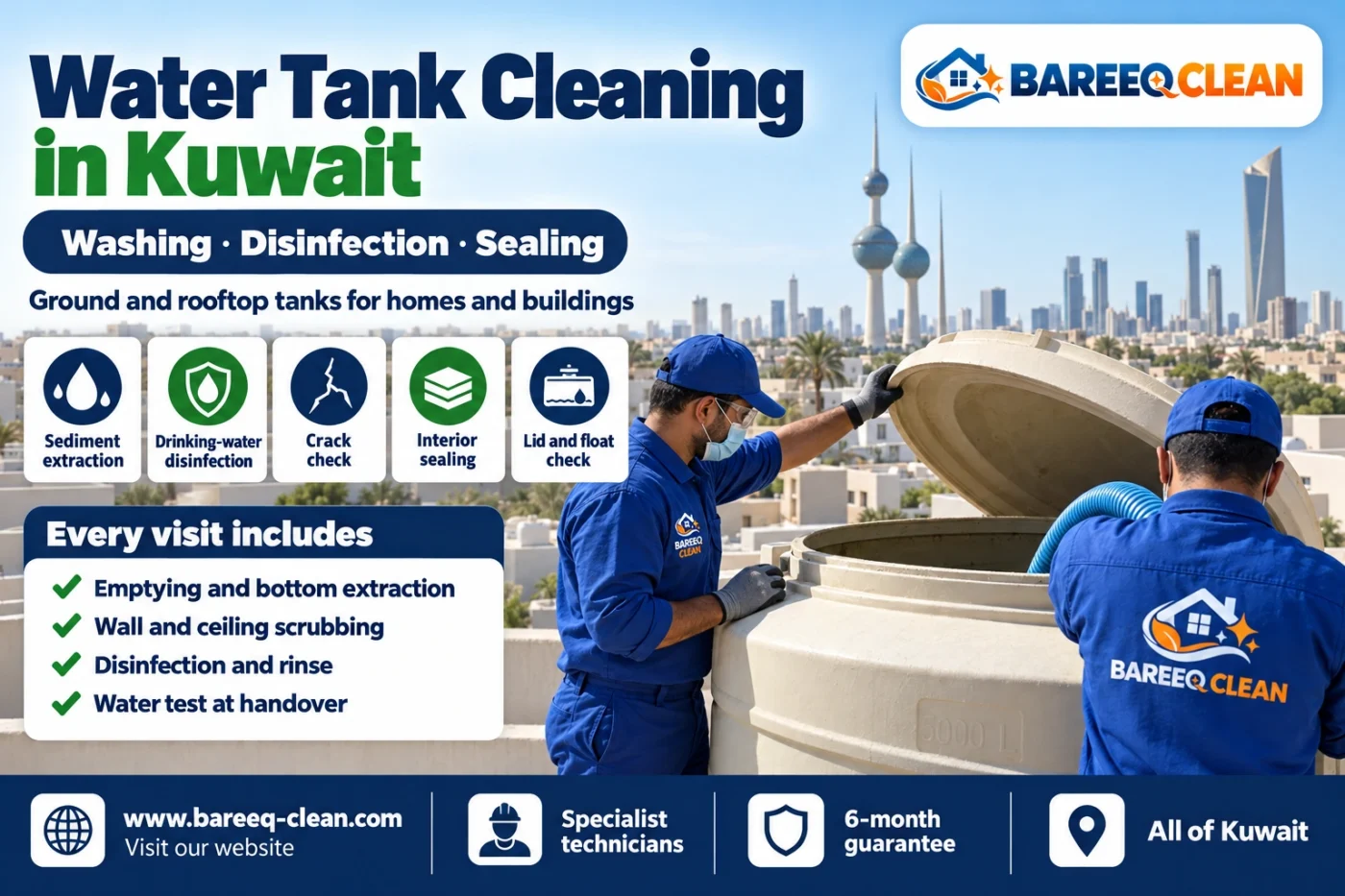
Bareeq Clean, a water tank cleaning company in Kuwait, washes and disinfects ground and rooftop water tanks for houses, villas, buildings and facilities: emptying, sediment extraction, scrubbing of the walls, then disinfection with a drinking-water product, rinsing and testing, along with interior tank sealing and leak detection. Rooftop tanks start from KWD 4.5, ground tanks from KWD 23 and tank sealing from KWD 2.8 per m², across every governorate of Kuwait, with a 6-month guarantee on cleaning.
Water tank cleaning in Kuwait, in brief
- Services: washing and disinfection of ground and rooftop tanks, interior sealing, leak detection, lid and float valve checks
- Rooftop tank up to 1,000 L: from KWD 4.5
- Home ground tank: from KWD 23
- Full wash-and-disinfection package: from KWD 14
- Building and facility tanks: from KWD 46
- Epoxy tank sealing: from KWD 2.8 per m²
- Duration: 1 to 4 hours depending on type and size
- Guarantee: 6 months on cleaning, 3 to 5 years on sealing
- Coverage: all six governorates: Capital, Hawalli, Farwaniya, Ahmadi, Jahra, Mubarak Al-Kabeer
- Working hours: daily, 7 am – 11 pm
Tell us the tank type (ground or rooftop), its rough capacity and your area, and get the price
Article Map23 sections · jump straight to what you need
- 1What does Bareeq Clean’s tank cleaning service include?
- 2Why do water tanks get dirty faster in Kuwait?
- 3How a dirty tank affects health and appliances
- 4Signs your tank needs cleaning now
- 5Ground tank cleaning in Kuwait
- 6Rooftop tank cleaning in Kuwait
- 7Types of water tanks in Kuwait and how each is cleaned
- 8Bareeq Clean’s water tank cleaning steps
- 9Water tank disinfection in Kuwait
- 10How to clean a water tank: what you can do and what to leave to a company
- 11Water tank sealing and insulation in Kuwait
- 12Tank leak detection and repair
- 13Lid, float valve, valves and vent maintenance
- 14Water tank cleaning for buildings and facilities in Kuwait
- 15How often should a tank be cleaned in Kuwait?
- 16Water tank cleaning prices in Kuwait
- 17How to choose a water tank cleaning company in Kuwait
- 18What sets Bareeq Clean apart in tank cleaning in Kuwait
- 19Related water tank services
- 20Areas we serve in Kuwait
- 21Service guarantee
- 22Article tags
- 23Frequently asked questions about water tank cleaning in Kuwait
What does Bareeq Clean’s tank cleaning service include?
Cleaning a tank is not spraying water inside it and filling it again. The visit starts with an inspection of the tank inside and out to see its type, the state of its lid and how much sediment it holds. It is then emptied, the sand and silt at the bottom are extracted, and the walls, ceiling and corners are scrubbed to remove slime and algae. Next the tank is disinfected with a product made for drinking-water tanks and left for the required contact time, rinsed until the smell of the disinfectant is gone, refilled, and the water is tested in front of you.
During the work the technician checks what homeowners rarely see: cracks in a concrete tank, the state of its interior coating, a float valve that lets the tank overflow, the valves and the vent opening. Anything that needs repair is explained to you first, with its price, and is only carried out with your approval.
Why do water tanks get dirty faster in Kuwait?
Most homes in Kuwait receive water from the Ministry of Electricity and Water network into a ground tank, and a pump then lifts it to a rooftop tank that feeds the bathrooms and kitchen. This means the water is stored twice, and whatever settles in the ground tank can be drawn upwards by the pump. Add Kuwait’s climate: summers above 45 °C, dust storms whose dust gets in through any loose opening, and rooftops exposed to the sun all day.
The table below shows the factors that make tanks in Kuwait need regular cleaning, and what is done for each:
| What is specific to Kuwait | Effect on the tank | What is done about it |
|---|---|---|
| Intense summer heat | Warm water where bacteria and algae grow faster | Clean before summer, shade or cool the rooftop tank |
| Dust storms | Dust and sand enter via the lid and vent | A tight lid and a mesh on the vent |
| Double storage (ground then rooftop) | Ground tank sediment is pumped up | Clean both together, ground tank first |
| Supply cuts and restarts | Surging water stirs up sediment in pipes | A sediment filter on the tank inlet |
| Iron pipes in older houses | Rust discolours the water | Replace with drinking-water pipes |
| White or translucent plastic tanks | Light passes through and green algae grow | A multi-layer opaque tank or a cover |
How a dirty tank affects health and appliances
Water may enter the tank looking clear, but it carries fine sand and salts that settle on the bottom layer upon layer. A thin slime forms on the walls where bacteria live, and if light reaches the water, algae grow. Through a broken lid or an unmeshed opening, insects and leaves fall in, and sometimes small birds and rodents. All of this reaches the tap with every strong draw of water.
The result can be stomach upsets and diarrhoea, especially in children and the elderly, and irritated skin and scalp after showering. Sediment also shortens the life of water heaters and washing machines and clogs shower heads, mixers and filters. Anyone who feels unwell after the water’s taste or smell changes should see a doctor and stop drinking from the tank until it is cleaned and disinfected.
Signs your tank needs cleaning now
Ground tank cleaning in Kuwait
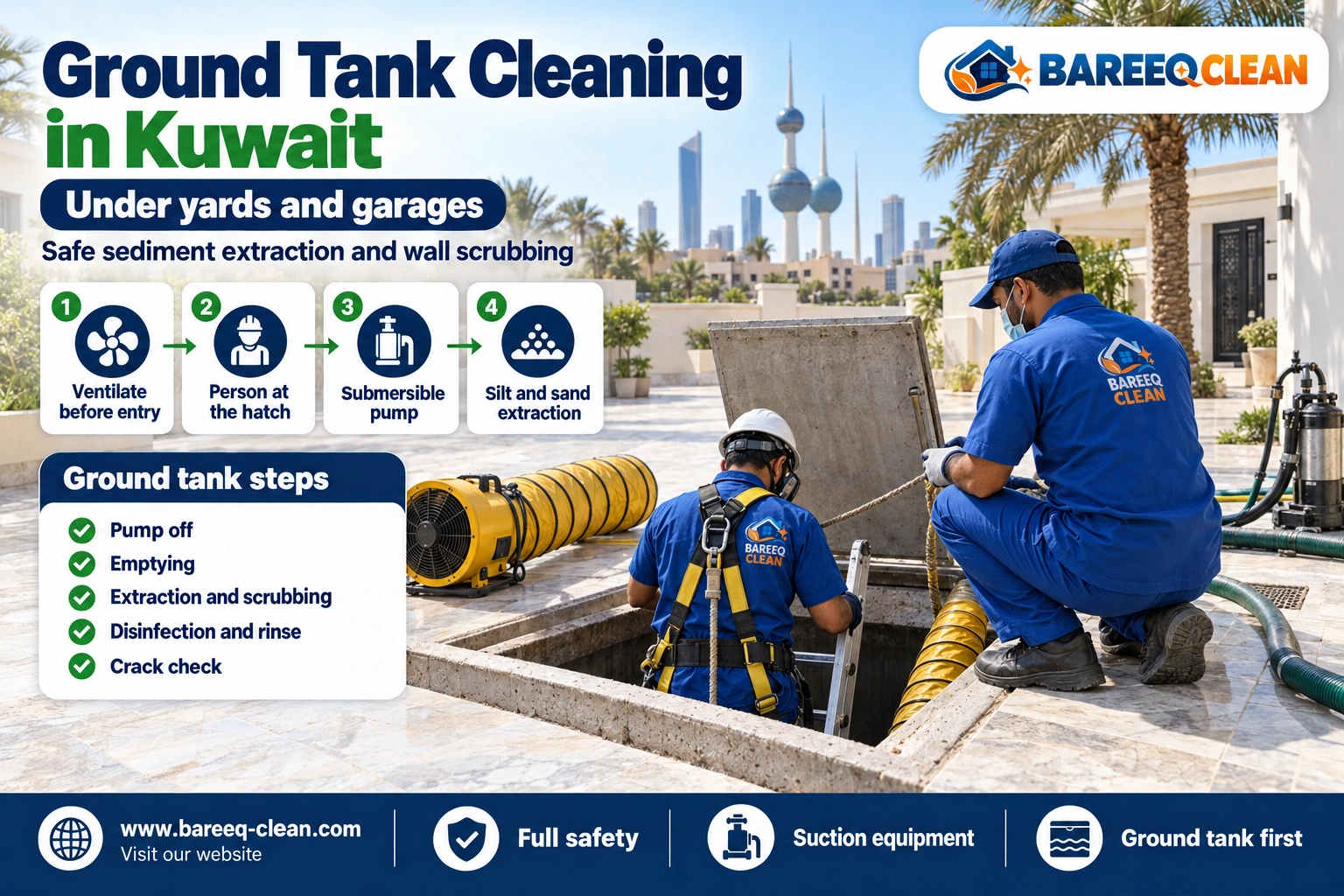
Ground tank cleaning in Kuwait is the hardest and most important part of the service, because the ground tank holds the most water and the most sediment, and it feeds the rooftop tank. In houses it is usually a concrete tank under the yard, the garage or the entrance steps, with a narrow hatch the technician climbs through. After the pump is switched off, the tank is emptied with a submersible pump, the water is drained away from the foundations, and the silt and sand on the bottom are extracted.
After extraction the walls and ceiling are scrubbed with long-handled brushes and pressurised water, with extra attention to the corners and around the inlet and outlet pipes where sediment gathers most. The tank is then disinfected and rinsed, and every crack and every patch of peeling coating is checked. Cleaning a home ground tank starts from KWD 23.
A ground tank under the garage or yard
A tank under the garage takes the weight and vibration of cars, so cracks appear more often, and its steel cover rusts over time and drops flakes into the water. Its ceiling and cover are checked on every visit, and a tight cover raised slightly above floor level is recommended so that water from washing the yard or from rain cannot get in.
Ground tanks in older houses
In houses built many years ago, the interior coating has often worn away in places, damp shows on the outside of the tank walls, or the water smells of soil. Cleaning alone is not enough here: the tank is cleaned, dried and re-sealed, otherwise water keeps seeping into the soil and drawing contaminants back in.
Rooftop tank cleaning in Kuwait
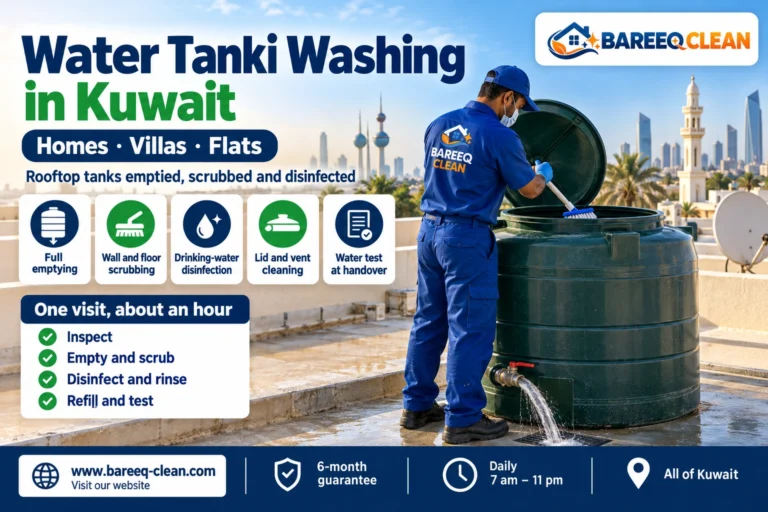
The rooftop tank is smaller than the ground tank but exposed to sun and dust, and it receives whatever the pump draws up. It is washed inside with a pressure that does not scratch its surface, and its lid, float valve, stand and vent opening are checked. It starts from KWD 4.5 for a tank up to 1,000 litres. For the full step-by-step guide to washing a home rooftop tank and how often to do it, read water tanki washing in Kuwait.
Types of water tanks in Kuwait and how each is cleaned
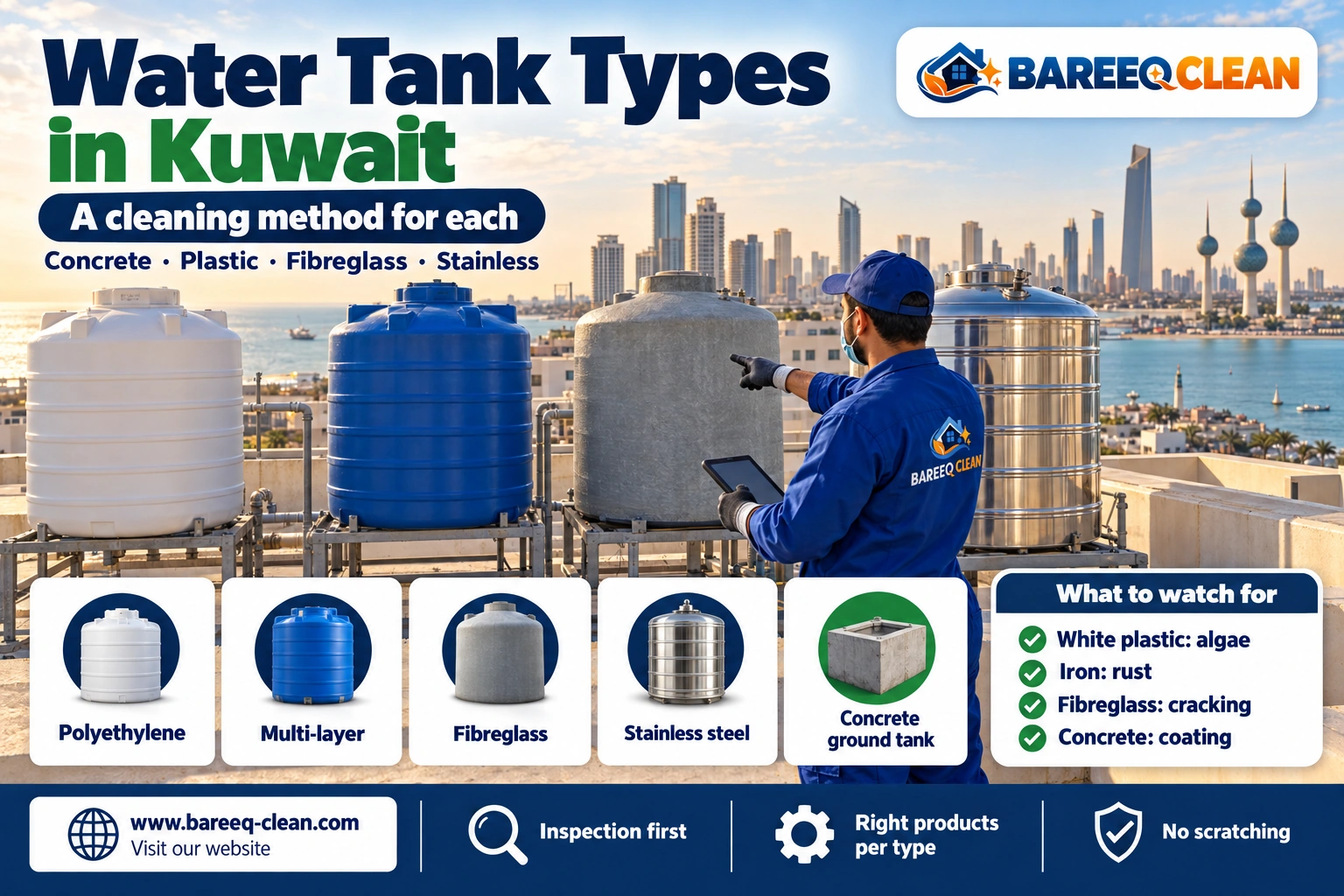
The cleaning method depends on what the tank is made of: what suits concrete may scratch plastic, and what is used on fibreglass is not used on iron. That is why the technician asks about the tank type before bringing the equipment.
The table summarises the tank types common in Kuwait and how each is handled:
| Type | Where it is found in Kuwait | Cleaning method | What to watch for |
|---|---|---|---|
| Concrete ground tank | Under houses and apartment buildings | Sediment extraction, wall scrubbing, crack and coating check | Peeling coating and leaks |
| Polyethylene (plastic) | The most common rooftop tank | Washing and scrubbing with a soft brush | White tanks let light in, so algae grow |
| Fibreglass | Rooftops and large tanks | Medium-pressure washing without scratching the inner layer | Cracking in the sun |
| Iron or galvanised steel | Older buildings | Rust removal, washing and lining check | Rust discolours the water |
| Stainless steel | Restaurants and facilities | Washing without concentrated chlorine | Pitting at welds |
| Sectional (panel) tanks | Large buildings and facilities | Emptying in stages and cleaning each section | Bolts and panel joints |
Cleaning plastic water tanks
A plastic tank has a smooth inner surface, so sediment does not cling to it much, but it is damaged by rough brushes and caustic products. It is washed with a soft brush and moderate water pressure, then disinfected and rinsed. If it is white or translucent, green algae reappear weeks after cleaning, and the lasting fix is to replace it with an opaque multi-layer tank or to cover it. The tanks available on the market are covered in water tanks for sale in Kuwait.
Cleaning rust from an iron water tank
Iron and galvanised steel tanks are still found in some older buildings. The tank is emptied, loose rust is scrubbed off, then it is washed and its inner lining checked. If rust has holed a wall or eaten the floor, replacement is safer than repair, because the rust will return and discolour the water however often it is cleaned.
Removing algae and limescale from a tank
Algae are removed by scrubbing followed by disinfection, and they only return quickly if light still reaches the water. Limescale, the hard white deposit on the walls and around the float valve, is removed mechanically; strong acids are not used inside a drinking-water tank.
Bareeq Clean’s water tank cleaning steps
These are the steps our team follows for every tank, ground or rooftop, with the equipment varying by size:
- First inspection: tank type, capacity, lid condition and amount of sediment.
- Pump off and valves closed: leaving enough water for the house during the work where possible.
- Emptying: with a submersible pump, draining the water away from the foundations.
- Sediment extraction: sand and silt from the bottom with a suction pump.
- Scrubbing walls, ceiling and corners: with long-handled brushes and pressurised water.
- First rinse: and removal of all the wash water.
- Disinfection: with a drinking-water disinfectant left for the required time.
- Final rinse: until the disinfectant smell is gone.
- Crack, coating, float valve and lid check: noting anything that needs repair.
- Refill and test: water clarity, smell and residual chlorine, in front of you.
Equipment used in tank cleaning
The table lists the core equipment our tank cleaning team carries and what each item is used for:
| Equipment | What it does |
|---|---|
| Submersible pump | Empties the tank |
| Sediment suction pump | Extracts sand and silt from the bottom |
| Pressure washer | Washes the walls and ceiling |
| Long-handled brushes | Corners and around the pipes |
| Damp-safe work light | Shows cracks and peeling coating |
| Ventilation fan | Refreshes the air in a ground tank before and during entry |
| Chlorine test strips or meter | Confirms the chlorine level after rinsing |
| Safety kit | Rope, harness, mask, rubber boots and a person at the hatch |
Send a photo of the tank and its hatch with your area and rough capacity, and get the price
Water tank disinfection in Kuwait
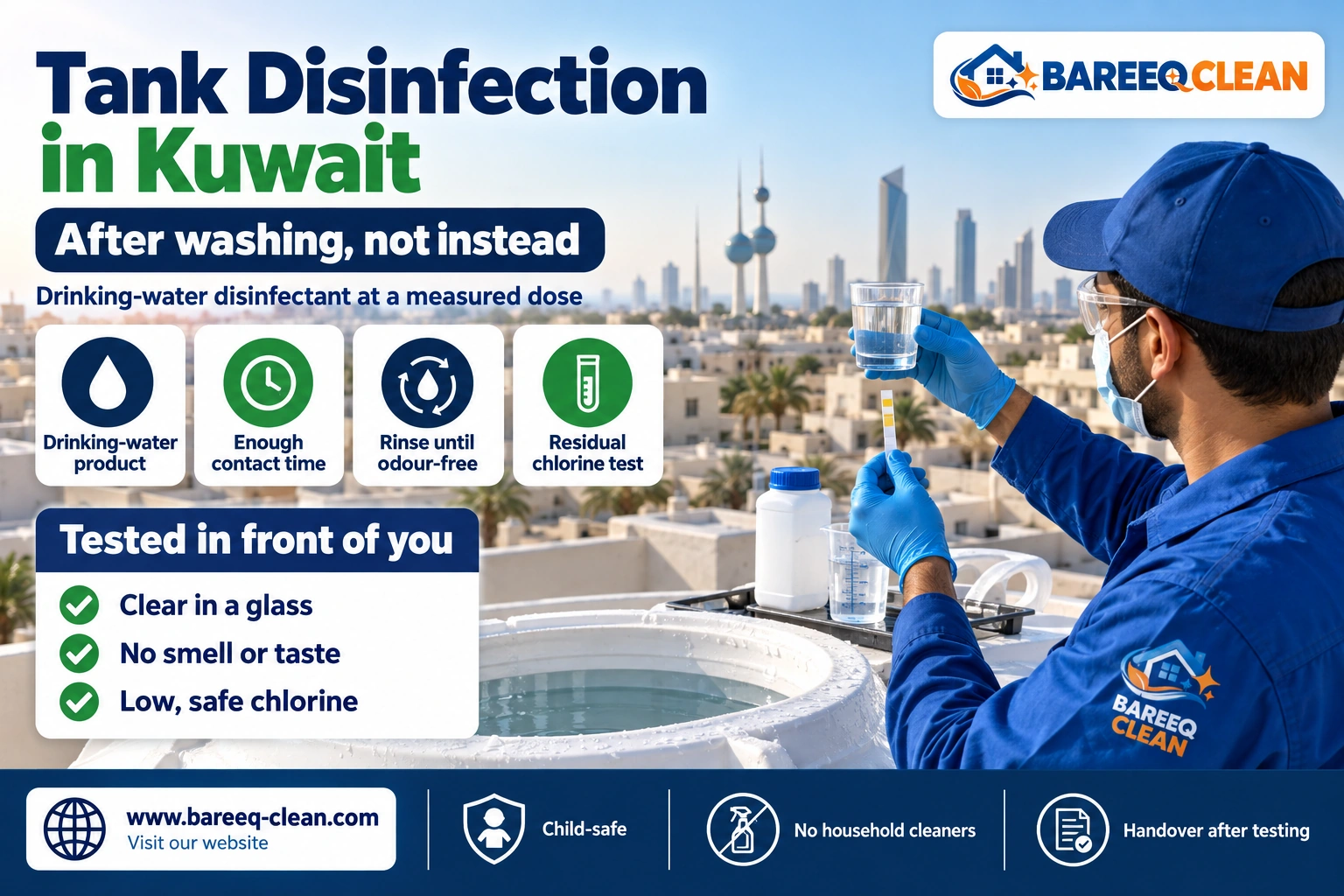
Water tank disinfection in Kuwait is the step that kills the bacteria you cannot see, after washing has removed the sediment and algae you can. That is why it follows washing rather than replacing it: disinfectant poured into a dirty tank is used up by the silt before it reaches bacteria shielded under the slime. A disinfectant made for drinking-water tanks is used at a dose the technician sets by tank capacity, left for the required contact time, and the tank is then rinsed until the water has no taste or smell.
Disinfection alone, after a recent wash, is requested in specific cases: after plumbing work on the pipes, after an animal or bird has fallen into the tank, before moving into a house that has been closed for weeks, and when water returns after a long supply cut.
Water tank disinfectants
The table shows the best-known tank disinfectants and how each works:
| Product | How it works | Note |
|---|---|---|
| Sodium hypochlorite (liquid chlorine) | Kills bacteria by oxidation | The most common; needs a measured dose and a thorough rinse |
| Chlorine tablets | Dissolve gradually, releasing chlorine | Suits small tanks and routine disinfection |
| Chlorine dioxide | A strong disinfectant with less taste | Used in facilities and large tanks |
| Hydrogen peroxide | Breaks down into water and oxygen | Suits chlorine-sensitive tanks such as stainless steel |
| Ozone | A disinfecting gas that breaks down quickly | Needs special equipment; used in facilities |
Products that never go into a drinking-water tank
Floor cleaners, soap and washing powder leave foam and residue that are hard to rinse out, scented household disinfectants are not made for water that people drink, and strong acids damage coatings and plastic. Adding household bleach to the tank without measuring gives the water a taste and smell and can cause harm. Anything that goes into the tank must be made for drinking water and used in a measured amount.
Testing the water after disinfection
After refilling, the water is tested in front of you: its clarity in a clear glass, the absence of smell and taste, and the residual chlorine measured with strips or a meter so it sits low, within drinking-water levels. If you need a laboratory bacteria test for a facility or restaurant tank, that is ordered from an accredited water lab, and we tell you so plainly.
How to clean a water tank: what you can do and what to leave to a company
A homeowner can wash a small plastic rooftop tank if they know the steps and follow the safety rules, as explained in our rooftop tank washing guide. Going down into a ground tank without equipment is never advised, and neither is tackling the large tanks of apartment buildings, because extracting sediment, ventilating the space and dosing the disinfectant need equipment and experience.
The table lists the most common mistakes in DIY tank cleaning and what each one leads to:
| Mistake | What it causes |
|---|---|
| Disinfecting without washing | Bacteria survive under the sediment |
| Using soap or household cleaners | Foam, taste and chemical residue |
| Scraping walls with a sharp tool | Scratched plastic and peeled coating |
| Unmeasured chlorine | Taste, smell and irritation |
| Filling over old stagnant water | Contaminates the fresh water |
| Cleaning the rooftop tank before the ground tank | Ground tank sediment is pumped back up |
| One person entering a ground tank alone | Risk of suffocation |
Water tank sealing and insulation in Kuwait
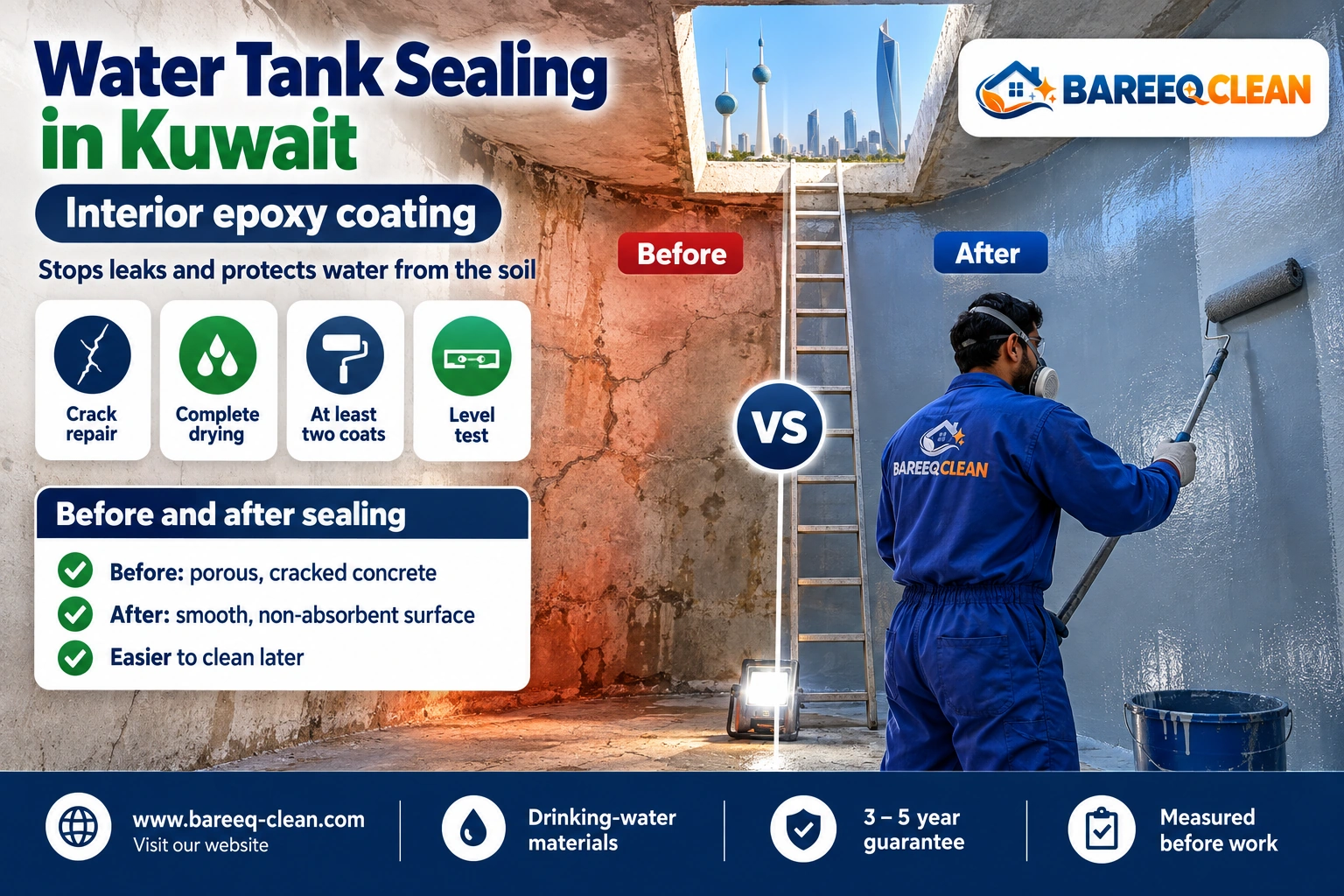
Water tank insulation in Kuwait covers two different jobs that people often confuse: interior waterproofing, which stops water seeping through the concrete and stops the soil contaminating the water, for concrete ground tanks; and external thermal insulation, which reduces how hot the rooftop tank water gets. Interior epoxy sealing starts from KWD 2.8 per m².
Sealing a concrete ground tank from inside
Concrete is porous however good it is, and an unsealed tank slowly leaks into the soil and takes in damp and salts from it. It is therefore sealed from inside with a material rated for contact with drinking water. The tank is cleaned and dried completely, cracks are injected and filled, corners and pipe penetrations are reinforced, then at least two coats are applied and left to cure for the time the material requires, after which the tank is filled and its level monitored before use.
The table compares common tank sealing materials and what each suits:
| Sealing material | What it is | Suits |
|---|---|---|
| Drinking-water epoxy | A hard, smooth, non-absorbent coating that is easy to clean | Sound concrete tanks, or after repair |
| Flexible cementitious coating | A modified cement layer that seals pores and tolerates slight movement | Tanks with many hairline cracks |
| Two-layer system | Cementitious coat followed by epoxy | Old tanks and building tanks |
| External thermal insulation | An insulating jacket or shade for the rooftop tank | Rooftop tanks exposed to the sun |
Insulating a rooftop water tank
A plastic or fibreglass rooftop tank does not need interior waterproofing; it is made to hold water. What people usually mean by “water tank insulation” is reducing its heat: an insulating jacket, a shade above it, or a cooling unit that lowers the water temperature in summer. This is explained in detail in water tank cooling in Kuwait, and roof insulation itself in roof insulation in Kuwait.
Water tank sealing prices
Interior sealing is priced per square metre of walls, floor and ceiling, starting from KWD 2.8 per m² with epoxy. The price rises if the tank needs extensive crack repair or a cementitious coat before the epoxy. The tank is measured first and you are told the price before work begins; the sealing guarantee is 3 to 5 years depending on the material.
Tank leak detection and repair
A rising water bill, a ground tank that fills slowly, damp on an adjacent wall or a pump that runs more than usual are all signs of a leak. Before breaking anything, a simple test is done: the pump is switched off and the valves closed, the water level is marked, and it is checked after 24 hours. If the level has dropped with the valves closed, the leak is in the tank; if not, the problem is in the house pipes or the float valve.
- Cracks in the walls and floor: injected and sealed after the tank is emptied and dried.
- Around inlet and outlet pipes: the most common leak points, reinforced with a flexible material.
- A faulty float valve: lets the tank overflow and waste water; it is replaced.
- The lid: replaced with a tight one that keeps out dust, insects and yard water.
- Valves and joints: tightened or replaced.
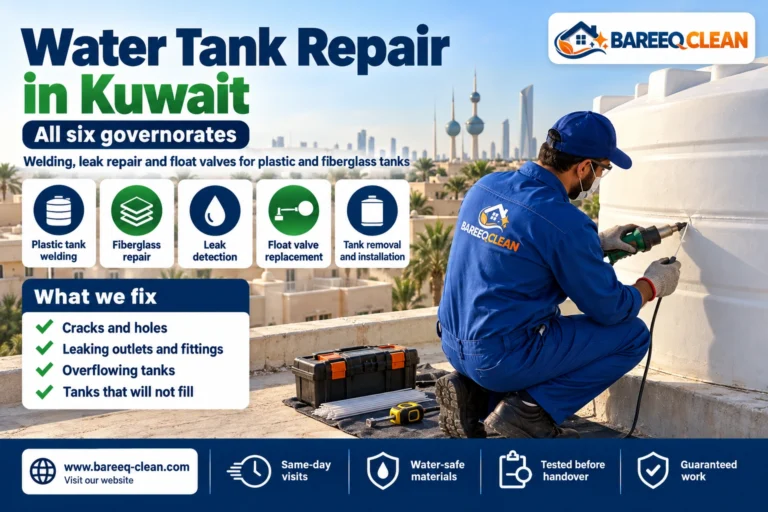
Welding a cracked plastic or fibreglass rooftop tank, and removing, installing or replacing a tank, are covered in water tank repair in Kuwait.
Lid, float valve, valves and vent maintenance
Much of what looks like tank contamination comes from its small parts: a sun-cracked lid that lets dust in, a vent without a mesh that lets insects in, or a float valve that does not shut properly so the tank overflows at night and soaks the roof. These are checked on every clean and worn parts are replaced with suitable ones. Old iron pipes between the ground tank and the rooftop tank rust inside and discolour the water even after both tanks are cleaned; the fix is to replace them.

Water tank cleaning for buildings and facilities in Kuwait
Building tanks are larger and more numerous, and dozens of residents depend on them at once, so their cleaning is planned to keep water interruptions short: one tank is cleaned while another stays in service, or a low-use time is chosen, and residents are informed through the building watchman or the owner. Cleaning building and facility tanks starts from KWD 46 and depends on the number of tanks and their capacity.
Periodic cleaning contracts for buildings and companies
For facilities that need regular cleaning, we agree a fixed visit schedule across the year at times that suit the site, with a short report after each visit noting the condition of the tanks, what was checked and what needs repair.
How often should a tank be cleaned in Kuwait?
The table shows the right cleaning frequency for each type of tank in Kuwait:
| Tank | Frequency | Note |
|---|---|---|
| Home ground tank | Every 6 months | Together with the rooftop tank |
| Home rooftop tank | Every 6 months | Especially before summer |
| Building tanks | Every 3 – 6 months | Depending on the number of residents |
| Restaurants and hotels | Every 3 months | High consumption |
| Old or metal tank | Every 3 months | More sediment and rust |
| A house that was closed | Before moving in | Water stagnant for weeks |
| After a heavy dust storm | Check, and clean if the water is cloudy | Dust entered through openings |
Water tank cleaning prices in Kuwait
The prices below are starting prices in Kuwaiti dinars. The final price depends on tank size, type, amount of sediment and ease of access, and you are told it before work starts.
The table shows starting prices for tank cleaning and sealing services in Kuwait:
| Service | From | Approximate time |
|---|---|---|
| Rooftop tank up to 1,000 L | KWD 4.5 | 1 hour |
| Tank 1,000 – 3,000 L | KWD 7.5 | 1 – 2 hours |
| Tank over 3,000 L | KWD 11 | 2 hours or more |
| Full wash-and-disinfection package | KWD 14 | Depends on the tank |
| Home ground tank | KWD 23 | 2 – 4 hours |
| Building and facility tanks | KWD 46 | Depends on number and capacity |
| Epoxy tank sealing | KWD 2.8 per m² | 1 – 3 days including curing |
| Tank leak detection and repair | Priced after inspection | 1 hour for the check |
What determines the price of tank cleaning?
- Capacity: every increase in size means more time emptying, scrubbing and rinsing.
- Type and location: a ground tank needs extraction, ventilation and a bigger team than a rooftop tank.
- Amount of sediment: a tank untouched for years differs from one cleaned six months ago.
- Access: a narrow hatch or a tank on a high roof without stairs needs extra preparation.
- Number of tanks: cleaning the ground and rooftop tanks together costs less than booking each separately.
The cheapest water tank cleaning in Kuwait
Our lowest tank cleaning price in Kuwait starts from KWD 4.5 for a small rooftop tank. Be careful, though: a very low price without disinfection or sediment extraction means the tank will be dirty again within weeks, so always ask what the price includes.
How to choose a water tank cleaning company in Kuwait
- Do they disinfect after washing? Washing alone is not enough.
- Do they extract sediment or just stir it? Stirred sediment is back in the water within days.
- Do they check cracks, coating and the float valve? That is what stops contamination returning.
- Does the technician enter a ground tank with ventilation and safety kit? And a person at the hatch.
- Is the price known before work starts? With nothing added afterwards.
- Is the work guaranteed for a stated period? Not a “guarantee” without a duration.
What sets Bareeq Clean apart in tank cleaning in Kuwait
Related water tank services
- Water tanki washing in Kuwait: step-by-step rooftop tank washing at home and its water problems.
- Water tank repair: leak welding, float valves, and tank removal, installation and replacement.
- Water tank cooling: for cooler water in Kuwait’s summer.
- Water tanks for sale: types, capacities and installation.
- Central water filters: and booster pumps after the tank.
- Cleaning company in Kuwait: homes, flats, villas, sofas and carpets.
Areas we serve in Kuwait
We cover all six governorates of Kuwait with tank cleaning teams working daily from 7 am to 11 pm. The table shows the main areas in each governorate:
| Governorate | Main areas |
|---|---|
| Capital | Sharq, Qibla, Dasma, Shuwaikh, Kaifan, Qadsiya, Rawda, Adailiya, Khaldiya, Yarmouk, Qurtuba, Surra, Nuzha, Faiha, Mansouriya, Doha, Sulaibikhat, Abdullah Al-Salem |
| Hawalli | Hawalli, Salmiya, Jabriya, Rumaithiya, Bayan, Mishref, Salwa, Shaab, Bidaa, Zahra, Salam, Hitteen, Siddiq, Shuhada, Mubarak Al-Abdullah |
| Farwaniya | Farwaniya, Khaitan, Ardiya, Jleeb Al-Shuyoukh, Rabiya, Andalous, Rehab, Omariya, Ferdous, Riggae, Ishbiliya, Sabah Al-Nasser, Abdullah Al-Mubarak |
| Ahmadi | Ahmadi, Fahaheel, Mangaf, Fintas, Mahboula, Abu Halifa, Riqqa, Sabahiya, Hadiya, Egaila, Dhaher, Wafra, Khairan, Sabah Al-Ahmad City |
| Jahra | Jahra, Saad Al-Abdullah, Qasr, Waha, Naeem, Oyoun, Taima, Naseem, Qairawan, Sulaibiya, Mutlaa, Abdali |
| Mubarak Al-Kabeer | Sabah Al-Salem, Qurain, Adan, Qusour, Messila, Abu Fatira, Fnaitees, Sabhan, Mubarak Al-Kabeer, Abu Al-Hasaniya |
Tank cleaning in Hawalli and Salmiya
Hawalli, Salmiya and Jabriya have many older apartment buildings with shared ground tanks, and we arrange their cleaning with the watchman at a low-use time.
Tank cleaning in Farwaniya and Khaitan
In Farwaniya, Khaitan, Ardiya and Jleeb Al-Shuyoukh we clean the tanks of houses and densely occupied buildings, where consumption is high and sediment builds up fast.
Tank cleaning in Jahra
Jahra, Saad Al-Abdullah, Qasr and Waha have many large houses with spacious ground tanks, and more dust in the storm seasons.
Tank cleaning in Ahmadi and Fahaheel
In Ahmadi, Fahaheel, Mangaf, Fintas and Mahboula we serve houses, buildings and the chalets of Khairan.
Service guarantee
6 months on tank cleaning and disinfection: if the water turns cloudy or sediment appears because of the work within that period, we clean again. 3 to 5 years on sealing, depending on the material. Details are on the service guarantee page.
Write the tank type, capacity and your area, and the floor number if the tank is on a building roof
Article tags
Company and service: water tank cleaning Kuwait · water tank cleaning company Kuwait · tank cleaning services Kuwait · water tank cleaning services near me · tank cleaning service near me · water tank cleaning services cost Kuwait · cheapest tank cleaning Kuwait · water tank disinfection Kuwait · tank sanitisation Kuwait · drinking water tank cleaning Kuwait
Types: ground tank cleaning Kuwait · underground water tank cleaning Kuwait · rooftop tank cleaning Kuwait · plastic water tank cleaning · iron tank rust removal · tank algae removal · building water tank cleaning Kuwait
Sealing: water tank sealing Kuwait · water tank insulation Kuwait · epoxy tank coating Kuwait · concrete tank waterproofing · tank leak detection Kuwait
Areas: tank cleaning Hawalli · tank cleaning Salmiya · tank cleaning Farwaniya · tank cleaning Jahra · tank cleaning Ahmadi · tank cleaning Mubarak Al-Kabeer · tank cleaning Kuwait City
Frequently asked questions about water tank cleaning in Kuwait
How much does water tank cleaning cost in Kuwait?
A rooftop tank up to 1,000 litres starts from KWD 4.5, a home ground tank from KWD 23, and the full wash-and-disinfection package from KWD 14. You get the final price before work starts.
How often should a water tank be cleaned in Kuwait?
Every 6 months for homes, every 3 months for buildings, restaurants and old tanks, plus an extra clean after a heavy dust storm or plumbing work.
How long does a ground tank clean take?
Two to four hours for a typical home ground tank; building tanks take longer depending on capacity and sediment.
Do you clean the ground and rooftop tanks in one visit?
Yes. The ground tank is cleaned first so the pump does not lift its sediment into a freshly cleaned rooftop tank.
Is the disinfectant safe for children and drinking water?
Yes. We use disinfectants made for drinking-water tanks at a measured dose, then rinse and test the residual chlorine before use.
Can I clean the ground tank myself?
It is not advised. A ground tank is a confined space with little air, and entering it without ventilation, safety gear and a person at the hatch is genuinely dangerous.
How much does tank sealing cost in Kuwait?
Interior sealing with drinking-water-grade epoxy starts from KWD 2.8 per square metre, calculated after measuring the walls and floor.
What is the best material to seal a water tank from inside?
Drinking-water-grade epoxy is the most common for concrete tanks, preceded by a cementitious coat when the walls have many cracks.
How do I know my ground tank is leaking?
Switch off the pump, close the valves, mark the water level and check after 24 hours. If the level drops, the leak is in the tank itself.
Do you clean tanks in buildings, schools and restaurants?
Yes. We schedule the work to keep water interruptions short and offer periodic cleaning contracts for facilities.
Is disinfection enough without washing?
No. Disinfectant cannot reach bacteria protected under sediment and slime, so the tank is washed first and then disinfected.
What should I do if the tank water changes colour or smells?
Stop drinking it and book a clean and disinfection. Brown usually means rust, green means algae and a bad smell means decaying organic matter.
Is tank cleaning guaranteed?
Yes, 6 months on cleaning and disinfection, and 3 to 5 years on sealing depending on the material.
Does a central filter replace tank cleaning?
No. A filter protects the taps, but a dirty tank clogs its cartridges quickly. Clean the tank first, then change the cartridges.
What are your working hours?
Daily from 7 am to 11 pm across all governorates of Kuwait.