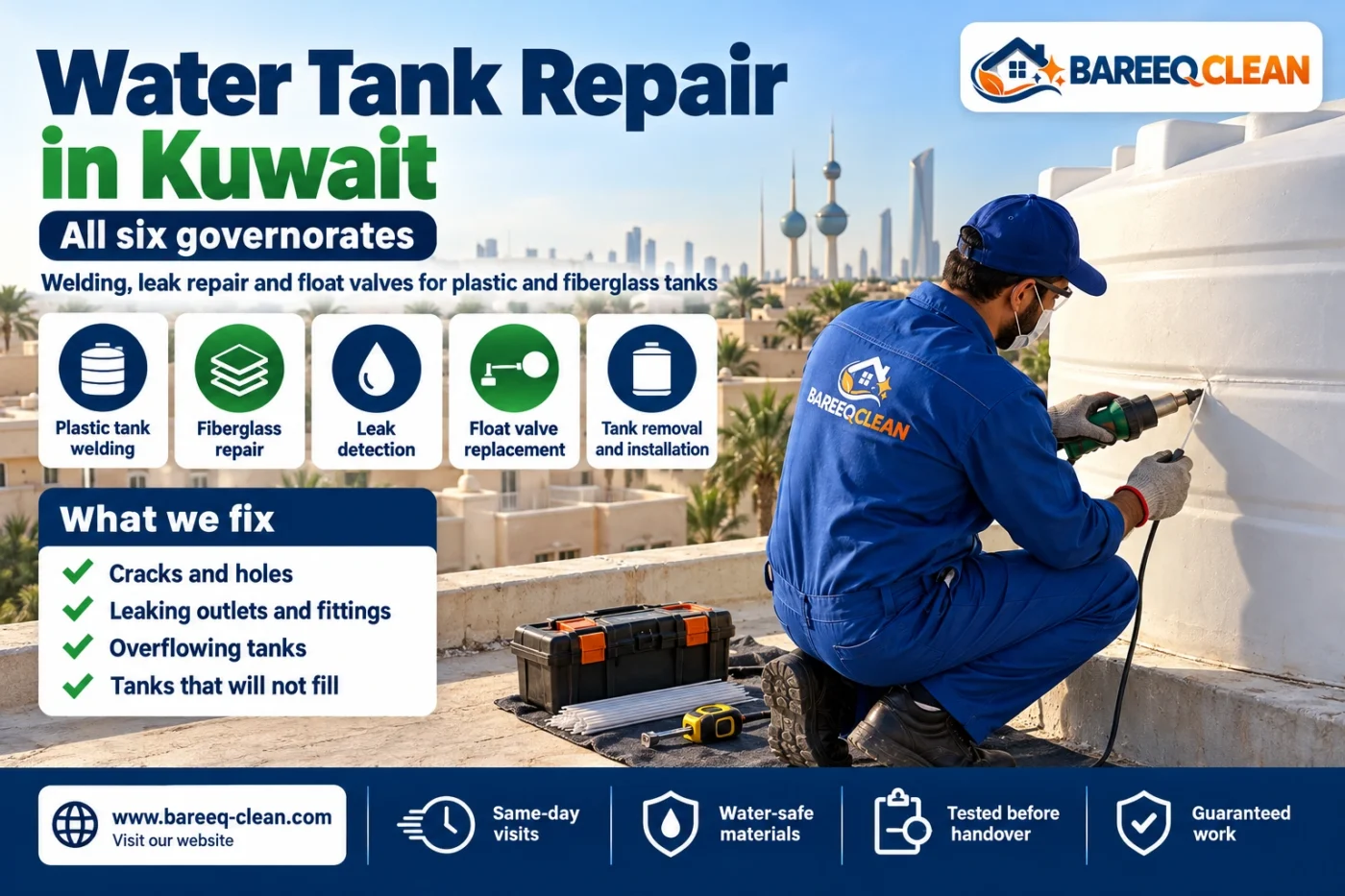
Water tank repair in Kuwait means stopping the leak from the tank body or its fittings and getting the tank working again without waste: heat welding for plastic tanks, layered fiberglass and resin repairs for fiberglass tanks, float valve and fitting replacement, and removing a failed tank and installing a new one, across every governorate of Kuwait. Plastic tank welding starts from KWD 14, fiberglass repair from KWD 18.5 and leak detection from KWD 9.
Tank repair in Kuwait, in brief
- Plastic tank welding (simple crack): from KWD 14
- Fiberglass tank repair: from KWD 18.5
- Full repair with sealing: from KWD 23
- Leak detection: from KWD 9
- Float valve replacement: mechanical from KWD 14, electric from KWD 74
- Tank removal and installation: from KWD 18.5
- Time: 1 to 3 hours, plus curing time
- Guarantee: one year on welding and installation, 3 to 5 years on sealing
- Coverage: all six governorates of Kuwait
- Working hours: daily, 7 am – 11 pm
Send a photo of the crack or leak, tell us the tank type (plastic or fiberglass), its size and your area, and get the price
Article Map19 sections · jump straight to what you need
- 1When does a water tank need repair?
- 2Why do water tanks fail in Kuwait?
- 3Water tank repair services in Kuwait
- 4Plastic water tank welding in Kuwait
- 5Fiberglass water tank repair in Kuwait
- 6Repairing steel, galvanised and ground tanks
- 7Finding the leak before the repair
- 8Water tank float valve repair
- 9Repairing valves and fittings around the tank
- 10Water tank repair steps
- 11When is replacing the tank better than repairing it?
- 12Water tank removal and installation in Kuwait
- 13Water tank repair prices in Kuwait
- 14How to choose a tank repair technician in Kuwait
- 15Keeping the tank in shape after repair
- 16Areas we serve in Kuwait
- 17Service guarantee
- 18Article tags
- 19Frequently asked questions about water tank repair in Kuwait
When does a water tank need repair?
A tank needs repair when it loses water nobody used, when a damp patch or puddle appears under its base, when it overflows from the overflow pipe, or when it stops filling. These signs usually show up before the owner sees the crack, because hairline cracks in rooftop tanks tend to sit on the sun-facing side, under the lid or around the bottom outlet, places nobody looks at unless they climb up and inspect the tank closely.
In Kuwaiti homes where a pump lifts water from the ground tank to the rooftop tank, a leak often shows up indirectly: the pump runs more than usual and keeps cutting in and out, or the water and electricity bills rise together. If paint is peeling on the bathroom or bedroom ceiling below the tank, water has been leaking for a while and must be stopped before it reaches the steel in the slab.
Why do water tanks fail in Kuwait?
A rooftop tank in Kuwait works in harsh conditions. Direct summer sun heats the tank body and the roof, then everything cools at night, so plastic and fiberglass expand and contract every single day. Over the years the outer UV-protective layer breaks down and the surface turns chalky and brittle, cracking at the first knock. Dust and sandstorms fill and scour fine cracks, and salty air in coastal areas such as Fahaheel, Mahboula and Abu Halifa speeds up rust on metal tanks and iron fittings.
Many failures come from installation rather than the tank itself: an uneven base that loads one side, a full tank resting on the edges of blocks with no board to spread the weight, or a rigid pipe tight on the outlet that pulls it every time the tank expands. Welding the crack is not enough if its cause remains, so a good technician checks the base and pipework before starting.
The table shows the most common causes of tank damage in Kuwait, their effect and the fix:
| Cause | Effect on the tank | Fix |
|---|---|---|
| Sun and UV rays | Chalky outer layer and hairline cracks | Welding plus a protective coat or shading |
| Daily expansion and contraction | Cracks at corners and openings | Weld, reinforce and free tight pipes |
| Sloping or uneven base | Uneven load and a cracked bottom | Level the base before repair |
| Salty coastal air | Rust on metal tanks and fittings | Corrosion-resistant fittings |
| Tank age | Brittle body in many places | Replace the tank |
| High pump pressure | Leaks at fittings and the float | Adjust pressure and renew washers |
Water tank repair services in Kuwait
The service covers everything that makes a tank hold its water again: plastic tank welding, fiberglass patching, sealing holes in metal tanks, treating cracks in concrete ground tanks, repairing floats, valves and fittings, and removing a failed tank to install a replacement. Each material has its own method. What works on polyethylene does not work on fiberglass, and a product used outside the tank may not be suitable for contact with drinking water inside it.
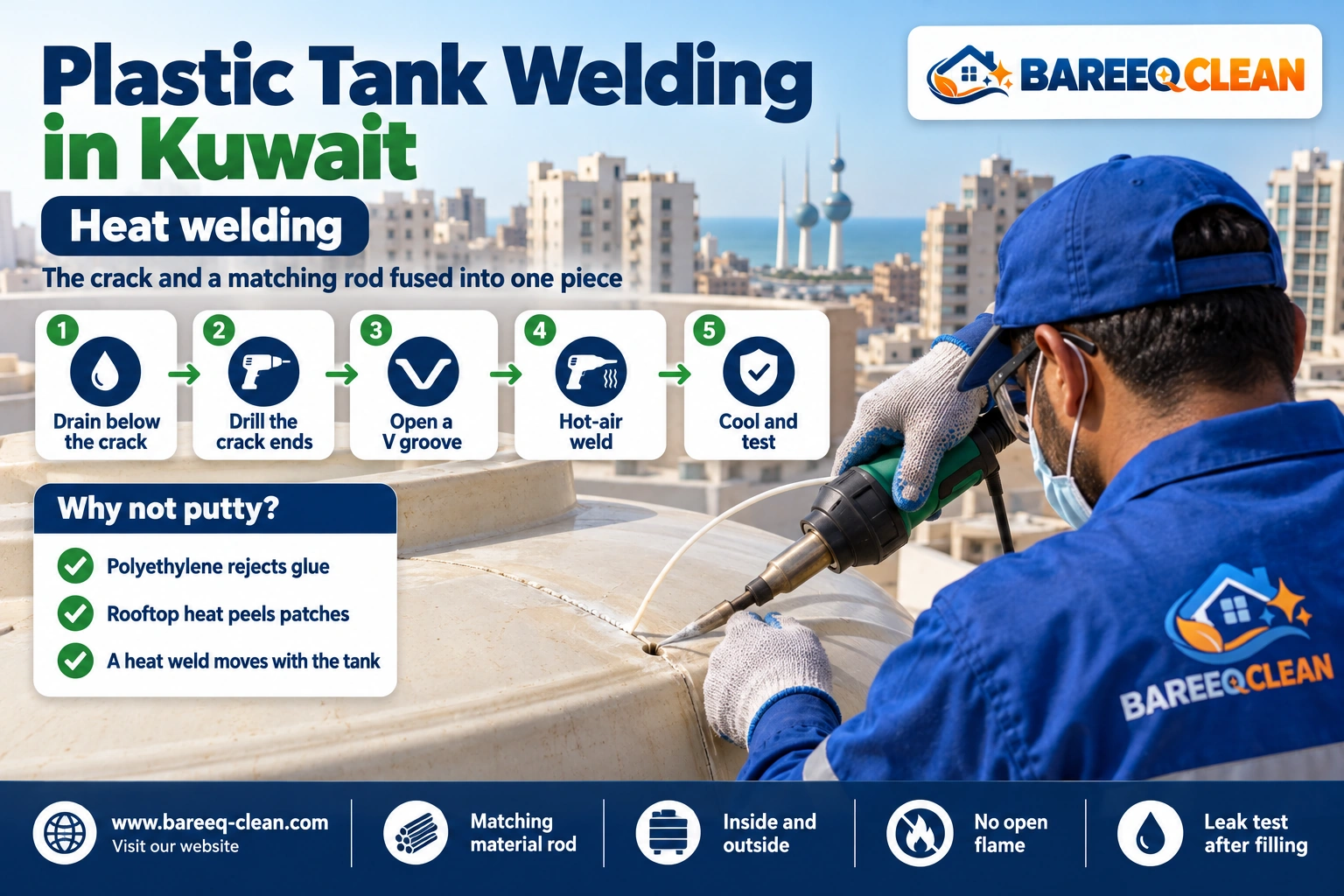
Plastic water tank welding in Kuwait
Plastic tank welding melts the edges of the crack together with a welding rod of the same polyethylene, using a hot-air welding gun, so the two fuse into one piece. This is the method that lasts on a hot Kuwaiti roof, because the welded spot expands and contracts with the rest of the tank. Glue, silicone and putty never truly bond to polyethylene: its surface is too smooth and waxy to hold adhesives, so a patch lets go after a few weeks of heat.
The job starts by draining the water below the crack and drying the area. A small hole is drilled at each end of the crack to stop it spreading, and the crack is opened into a V so the rod reaches its full depth. It is welded from outside, reinforced from inside where it can be reached, left to cool, then the tank is filled and watched. Welding a simple crack in a plastic tank starts from KWD 14.
Fixing a hole in a plastic water tank
A small hole from a nail or impact is treated with the same heat welding plus a polyethylene sheet patch that covers the hole and overlaps its edges by about two centimetres on every side. If the hole is at the bottom outlet or around a pipe fitting, replacing the tank connector with its washer is usually better than welding around it, because that spot carries the weight and movement of the pipe.
Is tank repair putty enough?
The epoxy putty sold in hardware shops stops a drip for a few days and can help as a stopgap until the technician arrives, but it is not a repair. Polyethylene does not bond with it, rooftop heat pushes it off, and some types are not made for drinking water contact. If you use it in an emergency, apply it outside only and tell the technician so it can be removed before welding.
Fiberglass water tank repair in Kuwait
Fiberglass tank repair rebuilds the broken area with layers of glass-fiber mat soaked in resin (polyester or epoxy), then seals it with a smooth gelcoat inside and a UV-resistant coat outside. Fiberglass tanks are strong but tire in the sun: the outer layer fades, white strands show in the fibers, then the smooth inner layer that touches the water cracks and seepage begins.
Done properly, the tank is drained and fully dried, the area around the break is sanded back to sound fibers to open the surface, then layers are laid one over another, each wider than the one below, with the resin rolled out to push out air bubbles. Once cured the surface is sanded and coated, left until the resin smell is gone, then washed and filled. Fiberglass tank repair starts from KWD 18.5 and rises with the size of the break and the number of layers.
Fiberglass welding for large cracks
A long crack, or a break running through a corner, needs more than a patch: cross strips of fiber are laid over it to spread the load, and the area is reinforced inside and out. If the break is in the floor of the tank, what lies under it is checked too, because a fiberglass bottom rarely breaks unless it sits on a stone or a raised edge, and repairing it without levelling the base only brings the break back.
The table compares repairing a plastic tank with repairing a fiberglass tank:
| Comparison | Plastic (polyethylene) tank | Fiberglass tank |
|---|---|---|
| Repair method | Heat welding with a matching rod | Fiber layers, resin and gelcoat |
| Does glue stick? | No, the smooth surface rejects adhesive | Resin bonds after sanding |
| Repair time | About an hour for a simple crack | 1 to 3 hours including curing |
| Typical faults | Cracks at openings and sun cracking | Cracked inner layer and corner breaks |
| Starting price | KWD 14 | KWD 18.5 |
Repairing steel, galvanised and ground tanks
Old metal tanks on the roofs of some homes, farms and livestock pens corrode from the inside before anything shows outside. A small hole is treated once the rust is removed back to sound metal, then sealed with a suitable patch material and a water-safe internal coating. If the water comes out brown or carries rust flakes, corrosion is widespread and patching will not hold, and replacing it with a polyethylene or fiberglass tank is cheaper and cleaner.
Cracks in concrete ground tanks are treated with injection and crystalline cement materials that close the pores, then the tank is lined inside. That work belongs to water tank cleaning and sealing in Kuwait, because a lining only goes onto a washed, dry tank. A full repair with sealing starts from KWD 23 for small tanks.

Finding the leak before the repair
Leak detection finds where the water really escapes before any welding, because the water you see under a tank may come from a fitting above it, from the overflow, or from a crack at the back. The check starts with a simple test: close the inlet valve, mark the water level inside the tank and use no water for two or three hours. If the level drops, the leak is in the tank or its lower fittings. If it holds, the problem is in the house pipes or the float.
The tank is then checked outside with a light and a probe, soapy water is sprayed around fittings to show bubbles, and for hidden cases a thermal camera shows damp in the ceiling or around the tank. Leak detection starts from KWD 9, and the repair is usually done on the same visit once the spot is found.
- Close the inlet valve: The valve that feeds the tank.
- Mark the level: With a marker on the inside wall or a strip of tape.
- Use no water: For two or three hours, or overnight.
- Compare the level: A drop means a leak in the tank or its lower fittings.
- Check around the base: New damp after the test shows the side.
Stopping a leak in an emergency
If water is pouring onto the roof at night, close the inlet valve and open a tap on the top floor so the level falls below the crack, and switch off the pump if it refills the tank automatically. The technician can stop the leak temporarily with a plug compound that sets under water until the tank is drained and properly repaired.
Water tank float valve repair
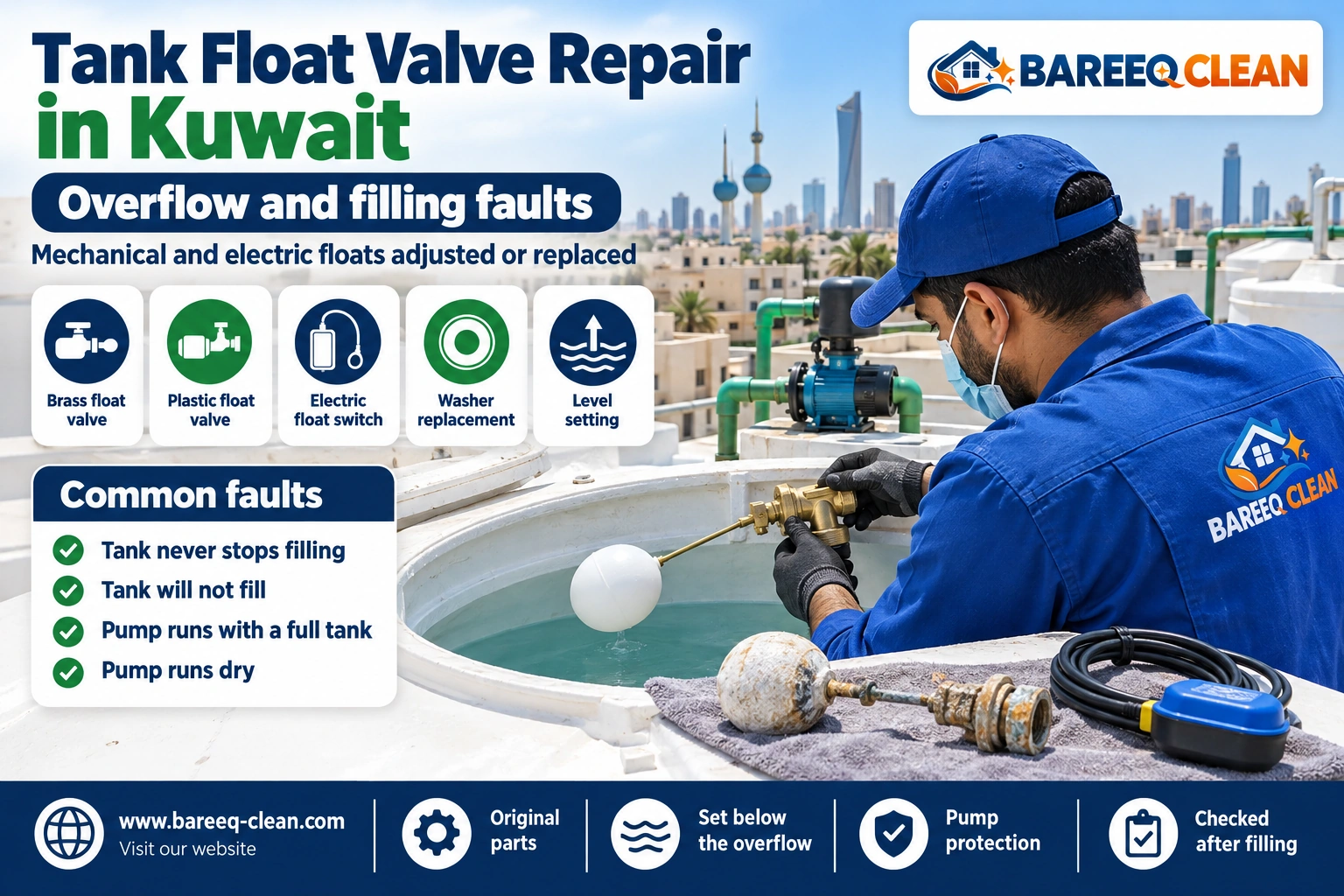
The float valve shuts off the incoming water when the tank is full, and when it fails you get one of two problems. Either the water never stops, so the tank overflows and water runs across the roof, or the float closes too early, the tank never fills and pressure in the house drops. The cause is usually a valve washer worn by mineral deposits, a bent arm, a ball that let water in and became heavy, or scale stopping the valve from moving.
A mechanical float (plastic or brass) is removed, cleaned and given a new washer if the body is sound, then set so the water stops a few centimetres below the overflow. An electric float that switches the pump is checked for wiring and its switching point. If it runs the pump when the tank is full, or lets it run dry, it must be replaced before the pump burns out. A mechanical float with fitting starts from KWD 14 and an electric float from KWD 74.
The table lists common float valve faults, their causes and fixes:
| Problem | Usual cause | Fix |
|---|---|---|
| Tank overflows and never stops | Worn washer or punctured ball | Replace the washer or float |
| Tank does not fill | Arm set too low or scale | Adjust the arm and clean the valve |
| Whistling while filling | Valve closing slowly | Replace the valve |
| Pump runs with a full tank | Stuck or failed electric float | Replace the electric float |
| Pump runs dry | Ground tank float not cutting out | Check and replace the protection float |
Photograph the float or the leak and tell us your area, and we will say whether an adjustment will do or a replacement is needed
Repairing valves and fittings around the tank
Roughly half of all “my tank is leaking” calls turn out to be a fitting or a valve rather than the tank body: the outlet connector has loosened, its washer has cracked in the heat, an iron valve has rusted inside, or the overflow pipe has come off so water runs down beside the base. These faults are usually fixed on the same visit without welding, by replacing the part with a corrosion-resistant plastic or brass one, rewrapping threads with PTFE tape, and leaving some flex in the pipework so it does not pull on the tank openings as the tank expands.
- Outlet connector: replaced with its washer rather than welded around.
- Old iron valves: swapped for brass or plastic ball valves.
- Overflow pipe: secured and directed away from the base and wall.
- Vent: covered with mesh that stops insects without blocking air.
- Lid: replaced if broken, since it lets dust and sunlight reach the water.
If weak pressure in the house comes from the pump rather than the tank, pump repair and booster pumps are covered in central water filters and pumps in Kuwait.
Water tank repair steps
- Inspection: Identify the tank type, the crack and its cause, and check the base and pipes.
- Shut off and drain: Drain below the fault, keeping some water for the house if possible.
- Preparation: Dry, clean and sand the area, and drill the crack ends to stop it spreading.
- Welding or patching: Heat welding for plastic, or fiber layers and resin for fiberglass.
- Reinforcing and coating: Strengthen the spot and apply a sun-protective coat outside.
- Curing: Let it cool or cure as the material requires.
- Washing and filling: Wash out the work dust and fill gradually.
- Testing: Watch the level, the repaired area and the fittings before handover.
If the inside is dirty or the tank has not been washed for more than six months, it makes sense to wash and disinfect it on the same visit while it is empty, as described in water tanki washing in Kuwait.
When is replacing the tank better than repairing it?
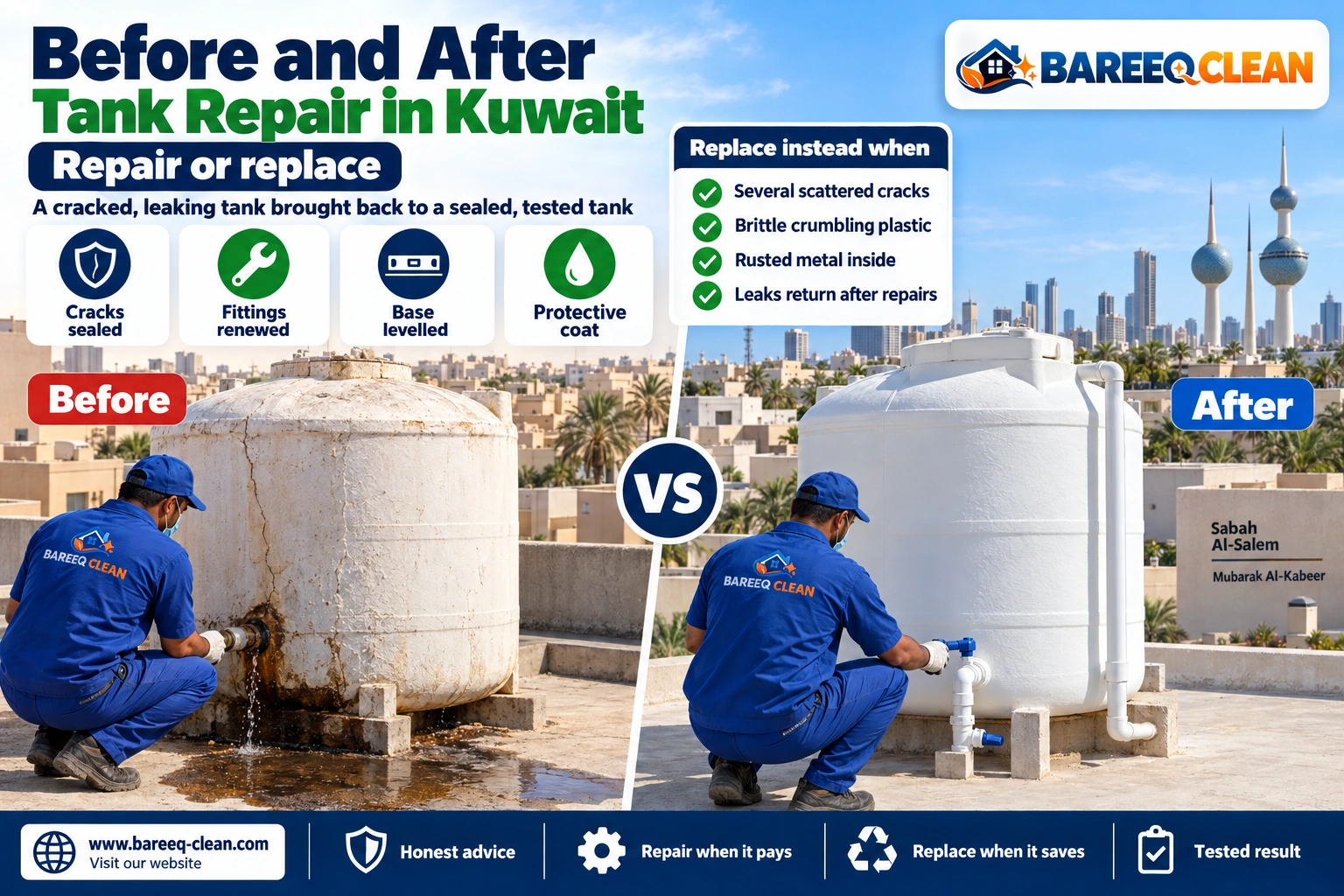
Repair is worthwhile as long as the tank body is sound around the fault. If the plastic has turned brittle and crumbles under finger pressure, if cracks keep appearing in different places, or if repeated repairs have cost more than half the price of a new tank, replacement is the better deal. An old thin or translucent tank that lets light through is worth replacing even if it holds water, because light grows algae inside it.
The table helps you choose between repair and replacement by tank condition:
| Tank condition | Decision | Reason |
|---|---|---|
| One crack or a small hole | Repair | Sound body, the weld will hold |
| Leak at a fitting or connector | Repair | Replacing the part is enough |
| Failed float or valve | Repair | A cheap part is swapped |
| Several scattered cracks | Replace | The whole body is weak |
| Brittle, crumbling plastic | Replace | The material has reached the end of its life |
| Metal tank corroded inside | Replace | Rust returns and stains the water |
| Leak returns after every repair | Replace | The cause is in the whole body |
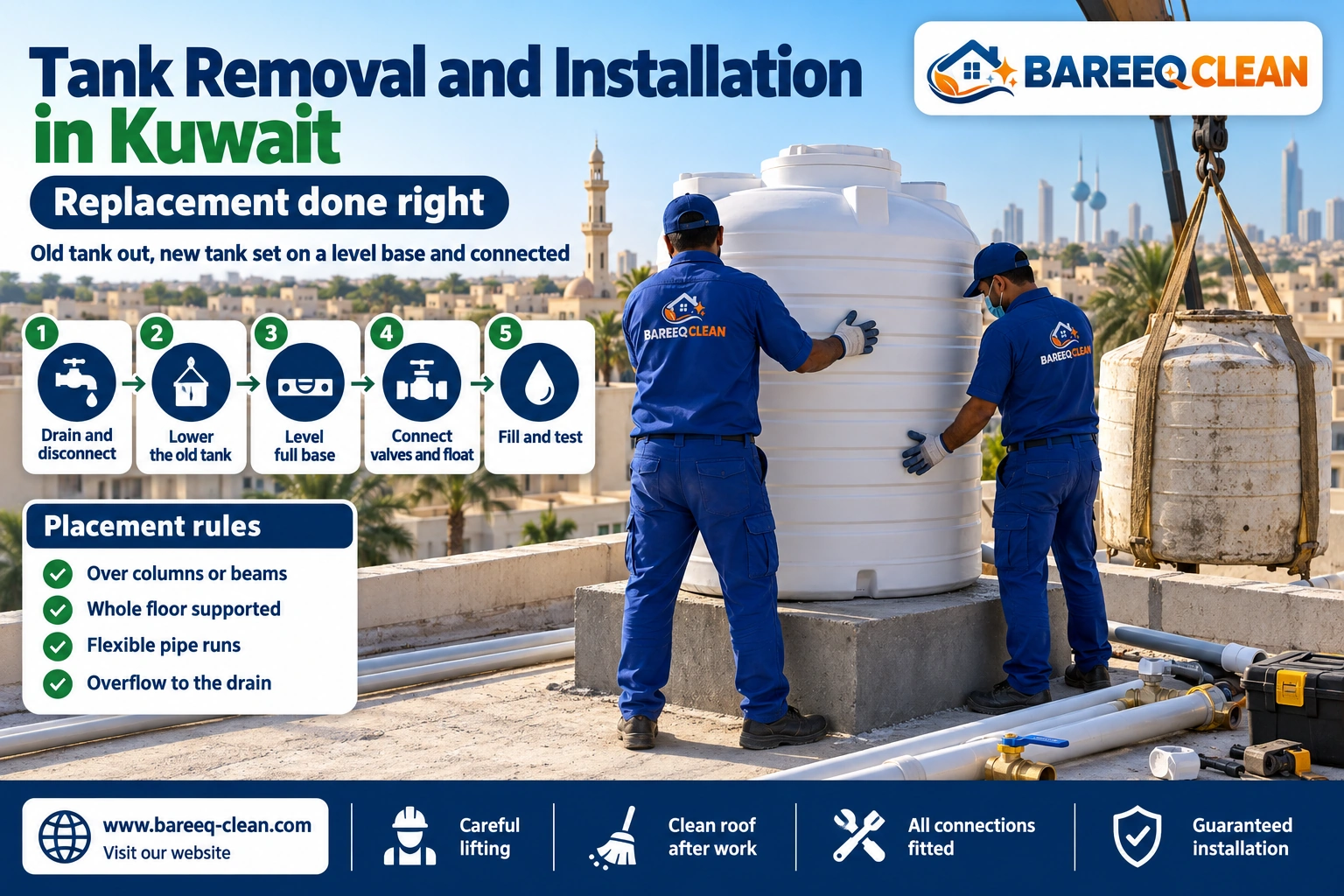
Water tank removal and installation in Kuwait
When replacing, the old tank is drained, disconnected and lowered from the roof, then the base is prepared: a fully level surface that supports the whole tank floor, not the edges of blocks under its rim. The new tank is lifted and secured, the connectors, valves, float, overflow and vent are fitted, then it is filled and tested. Tank removal and installation starts from KWD 18.5 including connections and the float, and rises for large tanks or roofs that are hard to reach.
Before choosing the new tank, work out the load on the roof: the water alone in a 1,000 imperial gallon tank comes to over four and a half tonnes, which is why it belongs over columns or beams rather than mid-slab. Tank types, the brands available and their prices are covered in water tanks for sale in Kuwait.
- A full level base: a board or slab that carries the whole floor.
- Over columns: not in the middle of the slab.
- Flexible pipe runs: so nothing pulls on the tank openings.
- Overflow to the drain: not onto the roof.
- Tight lid and meshed vent: so dust and insects stay out.
Water tank repair prices in Kuwait
These are starting prices in Kuwaiti dinars. The final price depends on the tank type, the length and position of the crack, the number of layers needed, how easy the tank is to reach and whether new parts are required, and you are told it before work begins.
The table summarises tank repair prices in Kuwait and the time each job takes:
| Service | From | Approx. time |
|---|---|---|
| Leak detection | KWD 9 | 30 minutes to 1 hour |
| Simple crack weld, plastic tank | KWD 14 | 1 hour |
| Fiberglass tank repair | KWD 18.5 | 1 to 3 hours with curing |
| Full repair with sealing | KWD 23 | Depends on area and drying |
| Mechanical float replacement | KWD 14 | 30 minutes |
| Electric float replacement | KWD 74 | 1 hour |
| Tank removal and installation with connections | KWD 18.5 | About 2 hours |
| Damaged metal or ground tank | Priced after inspection | Depends on condition |
The cheapest tank repair in Kuwait
The cheapest repair in Kuwait is the one done right the first time: a heat weld instead of putty that fails in two weeks, and a one-dinar washer instead of a whole new float. The cheapest way to get an accurate price is to send a clear photo of the crack and one of the whole tank with its openings.
How to choose a tank repair technician in Kuwait
- Do they heat weld or use putty? Putty is temporary.
- Do they check the cause of the crack? Base and pipes before welding.
- Do they test the tank after filling? And stay until the level holds.
- Are the materials safe for drinking water? Especially inside the tank.
- Is the price clear before work starts? With nothing added afterwards.
- Is there a guarantee with a set period? Naming the repaired spot.
Keeping the tank in shape after repair
A repaired tank lasts for years if you ease the same causes. Shade the rooftop tank with a canopy or insulated cover, which protects the plastic from UV and also keeps the water cooler, as covered in water tank cooling in Kuwait. Keep loose items on the roof away from the tank in storms, check the float and valves every few months, and wash the tank regularly, because sediment slows the float and clogs the washers.
- Shade the rooftop tank or fit an insulated cover.
- Check for damp at the base after storms and very hot days.
- Keep pipes flexible and hang nothing on them.
- Do not set the pump pressure higher than the house needs.
- Wash the tank every six months.
Areas we serve in Kuwait
We repair tanks in all six governorates of Kuwait, for houses, villas, flats and apartment buildings:
The table lists Kuwait governorates and some of the areas where we repair water tanks:
| Governorate | Areas include |
|---|---|
| Capital | Shuwaikh, Dasma, Qadsiya, Kaifan, Shamiya, Rawda, Yarmouk, Adailiya, Faiha, Qurtuba, Surra, Khaldiya |
| Hawalli | Salmiya, Hawalli, Jabriya, Mishref, Bayan, Rumaithiya, Salwa, Shaab, Zahra, Salam, Hitteen |
| Farwaniya | Farwaniya, Khaitan, Jleeb Al-Shuyoukh, Ardiya, Rabiya, Andalus, Rehab, Omariya, Ishbiliya, Firdous, Abdullah Al-Mubarak |
| Ahmadi | Fahaheel, Mangaf, Fintas, Mahboula, Abu Halifa, Riqqa, Sabahiya, Hadiya, Egaila, Dhaher, Sabah Al-Ahmad |
| Jahra | Jahra, Saad Al-Abdullah, Qasr, Naeem, Naseem, Waha, Oyoun, Taima |
| Mubarak Al-Kabeer | Sabah Al-Salem, Qurain, Adan, Qusour, Messila, Abu Fatira, Fnaitees |
Tank repair in Hawalli and Salmiya
Hawalli, Salmiya and Jabriya have many apartment buildings with several tanks on the roof, and most faults there are at fittings and floats because of pump pressure, so we check every tank on the visit, not only the leaking one.
Tank repair in Ahmadi and Fahaheel
In Fahaheel, Mangaf, Mahboula and Abu Halifa sea air speeds up rust on iron valves and metal tanks, so we replace them with corrosion-resistant parts during the repair.
Tank repair in Jahra and Farwaniya
In Jahra, Saad Al-Abdullah, Khaitan and Ardiya dust is heavy, vents clog and floats get loaded with sediment, so we check them with every weld.
Service guarantee
One year on the weld and installation work, 3 to 5 years on sealing, and the dealer warranty on new parts such as floats and valves. Details are on the service guarantee page.
Tell us the tank type, its size, where it leaks and your area in Kuwait, and get the price before the visit
Article tags
Repair: water tank repair Kuwait · tanki repair Kuwait · water tank leak repair · water tank maintenance Kuwait · tank washing and repair
Welding: plastic water tank welding · fiberglass tank repair Kuwait · fiberglass welding Kuwait · plastic tank hole repair · tank repair putty
Parts and installation: tank float valve repair · float valve replacement Kuwait · water tank installation Kuwait · tank removal and installation · tank leak detection
Areas: tank repair Hawalli · tank repair Salmiya · tank repair Farwaniya · tank repair Jahra · tank repair Ahmadi · tank repair Mubarak Al-Kabeer
Frequently asked questions about water tank repair in Kuwait
How much does water tank repair cost in Kuwait?
Welding a simple crack in a plastic tank starts from KWD 14, fiberglass tank repair from KWD 18.5, a full repair with sealing from KWD 23 and leak detection from KWD 9. The final price is given after we see the crack or a photo of it.
Is welding a plastic water tank a permanent fix?
Yes, when it is heat welding with a rod of the same polyethylene on a clean, dry surface, because the two materials fuse into one. Putty and silicone are temporary and peel off in rooftop heat.
Can a broken fiberglass tank be repaired?
In most cases, yes. The area is sanded and rebuilt with layers of fiberglass mat and resin, then sealed with gelcoat. If cracks are spread across a weakened body, replacing the tank costs less.
Does the tank have to be drained before repair?
For a lasting repair, yes: the water is drained below the crack and the surface dried. In an emergency a small leak can be stopped with a plug compound that sets under water, then repaired properly after draining.
How long does a tank repair take?
One to three hours for welding or patching. Fiberglass resin needs another 30 minutes to two hours to cure before the tank is refilled.
Why does a tank leak again after repair?
Usually because the surface was not dried or sanded, putty was used instead of welding, or the visible crack was fixed while its cause, such as a sloping base or a pipe pulling on an outlet, was left in place.
How much is a float valve replacement in Kuwait?
A mechanical float valve with fitting starts from KWD 14, and an electric float switch that controls the pump starts from KWD 74.
My tank keeps overflowing. What is wrong?
Most often a stuck float, a worn valve washer, or an arm set above the overflow level. The float is adjusted or replaced.
How can I tell if my tank is leaking?
Close the inlet valve, mark the water level inside the tank and use no water for two or three hours. If the level drops, the leak is in the tank or its lower fittings.
Do you repair steel and galvanised tanks?
Yes, small holes are treated after the rust is removed. A metal tank corroded inside in several places is better replaced with a polyethylene or fiberglass tank.
Do you remove an old tank and install a new one?
Yes. Removing and installing a tank with its connections and float starts from KWD 18.5, depending on size and roof access.
Are the repair materials safe for drinking water?
Inside the tank we use welding rods of the same material and resins and coatings made for water contact, and the tank is washed and rinsed before its water is used.
Can a tank be repaired while it is full?
Only a temporary stop is possible. Welding and patching need a dry surface, so the tank is drained below the crack.
Is there a guarantee on tank repair?
Yes: one year on the weld and installation work, 3 to 5 years on sealing, and the dealer warranty on new parts such as floats.
Do you cover all areas of Kuwait?
Yes, all six governorates: Capital, Hawalli, Farwaniya, Ahmadi, Jahra and Mubarak Al-Kabeer, daily from 7 am to 11 pm.