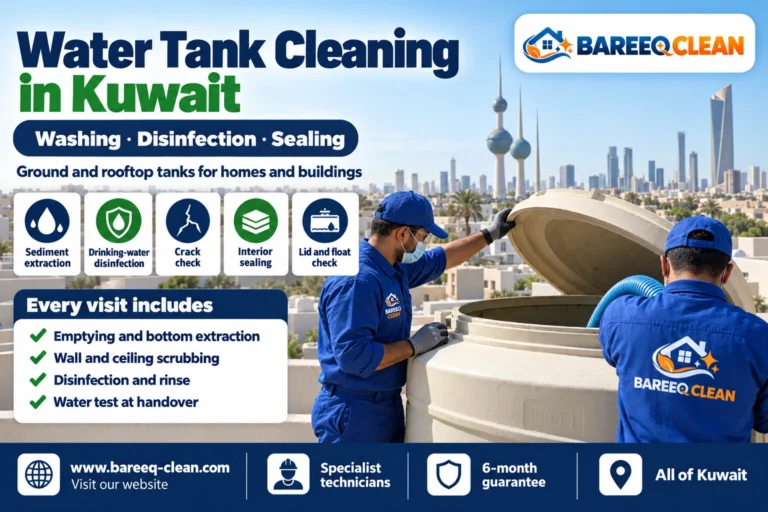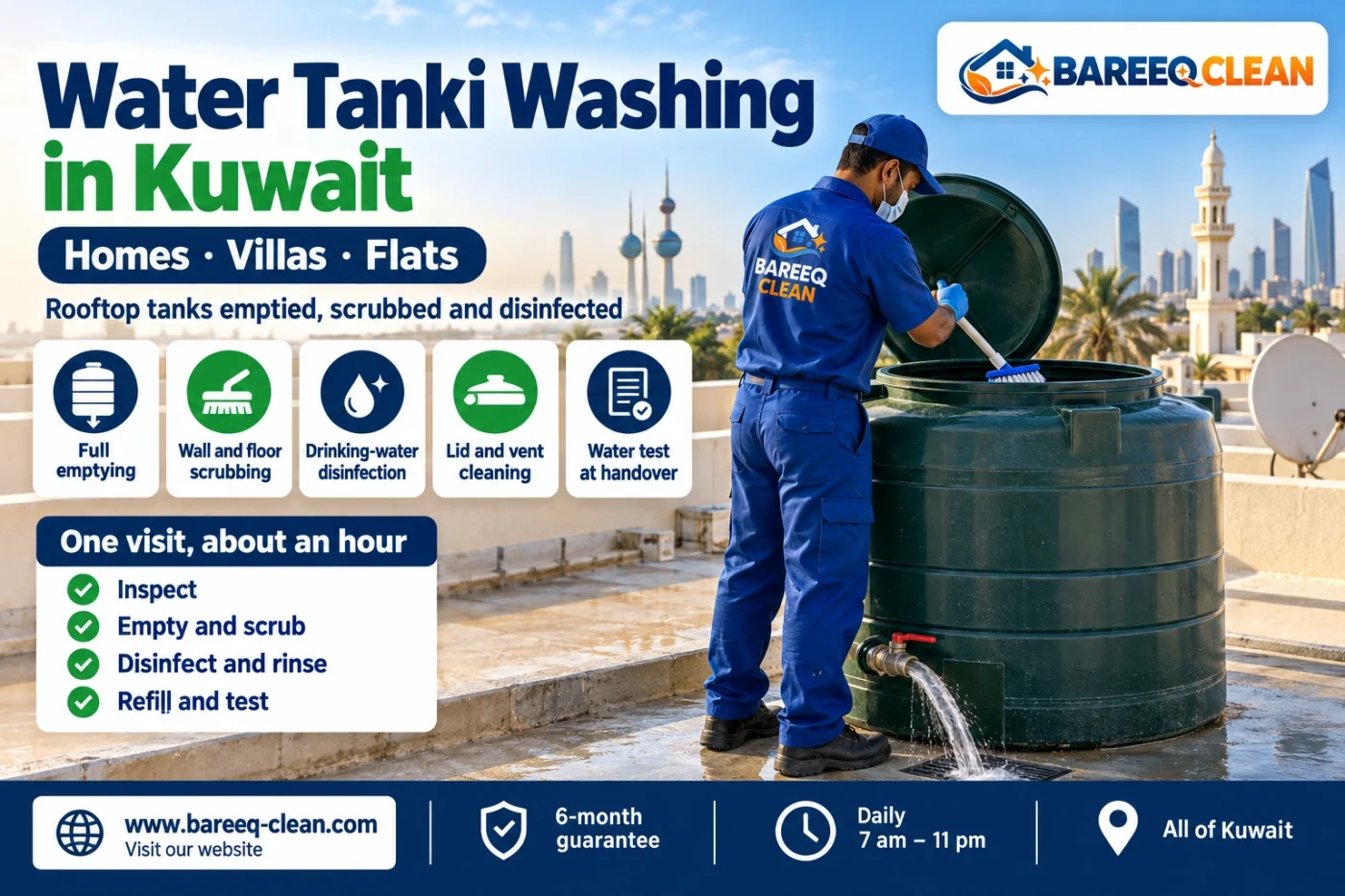
Water tanki washing in Kuwait by Bareeq Clean means emptying the rooftop tank of your house or villa, scrubbing its walls and floor free of sand, algae and rust, then disinfecting it with a drinking-water product, rinsing it and testing the water before handover. Washing a tank up to 1,000 litres starts from KWD 4.5, larger tanks from KWD 7.5, and the full wash-with-disinfection package from KWD 14, in every area of Kuwait.
Tanki washing in Kuwait, in brief
- Service: washing and disinfection of rooftop tanks for houses, villas, flats and buildings
- Tank up to 1,000 L: from KWD 4.5
- Tank 1,000 – 3,000 L: from KWD 7.5
- Tank over 3,000 L: from KWD 11
- Wash with full disinfection: from KWD 14
- Duration: about one hour for a home tank
- How often: every 6 months, and before summer
- Guarantee: 6 months on washing
- Coverage: all governorates of Kuwait
- Working hours: daily, 7 am – 11 pm
Tell us how many tanks you have, their capacity and material (plastic, fibreglass, iron) and your area, and get the price
Article Map19 sections · jump straight to what you need
- 1What happens during a tanki washing visit?
- 2Why do rooftop tanks get dirty in Kuwaiti homes?
- 3Signs your tanki needs washing
- 4Tanki water problems: cause and fix
- 5Tanki washing step by step
- 6Tank washing with disinfection
- 7How to clean a water tanki yourself
- 8Rooftop tank types and how each is washed
- 9Washing the tanks of a house or villa
- 10How often should a water tanki be washed in Kuwait?
- 11Water tanki washing prices in Kuwait
- 12What to prepare before the technician arrives
- 13How to keep the tanki clean after washing
- 14Common tanki washing mistakes
- 15Related tank services
- 16Tanki washing in every area of Kuwait
- 17Service guarantee
- 18Article tags
- 19Frequently asked questions about water tanki washing in Kuwait
What happens during a tanki washing visit?
A home tanki washing visit is short and orderly: the technician arrives, goes up to the roof and inspects the tank before touching it, then switches off the pump so no new water enters during the work. The tank is then emptied, washed and scrubbed on the walls and floor, disinfected and rinsed, after which the pump is switched back on and you check the water at the nearest tap. The technician only enters the rooms of the house if a tap needs opening to drain what is left in the pipes.
The table shows the stages of a home tanki washing visit and roughly how long each takes:
| Stage | Approximate time | What happens |
|---|---|---|
| Inspection and set-up | 5 – 10 minutes | Tank type, lid, float valve, amount of sediment |
| Emptying | 10 – 20 minutes | With a small pump or through the drain valve |
| Washing and scrubbing | 15 – 30 minutes | Walls, floor, ceiling and corners |
| Disinfection | Depends on the product | Drinking-water disinfectant left for its contact time |
| Rinse and refill | 10 – 20 minutes | Until the disinfectant smell is gone |
| Check and handover | 5 minutes | Water clarity and smell, in front of you |
Why do rooftop tanks get dirty in Kuwaiti homes?
The tank on the roof lives in the harshest spot of the house: direct sun from morning to sunset, airborne dust on any day, and dust storms that fill every opening. In most houses the water reaching it does not come straight from the network; the pump draws it from the ground tank, along with the sand and silt that have settled there. If the tank lid has cracked in the sun, or the vent pipe has no mesh, dust and insects get in, and if the tank is white and lets light through, algae grow.
In summer the water in the tank gets very warm, and warm, still water is where bacteria multiply fastest. That is why a rooftop tank in Kuwait needs washing more regularly than one in a mild climate.
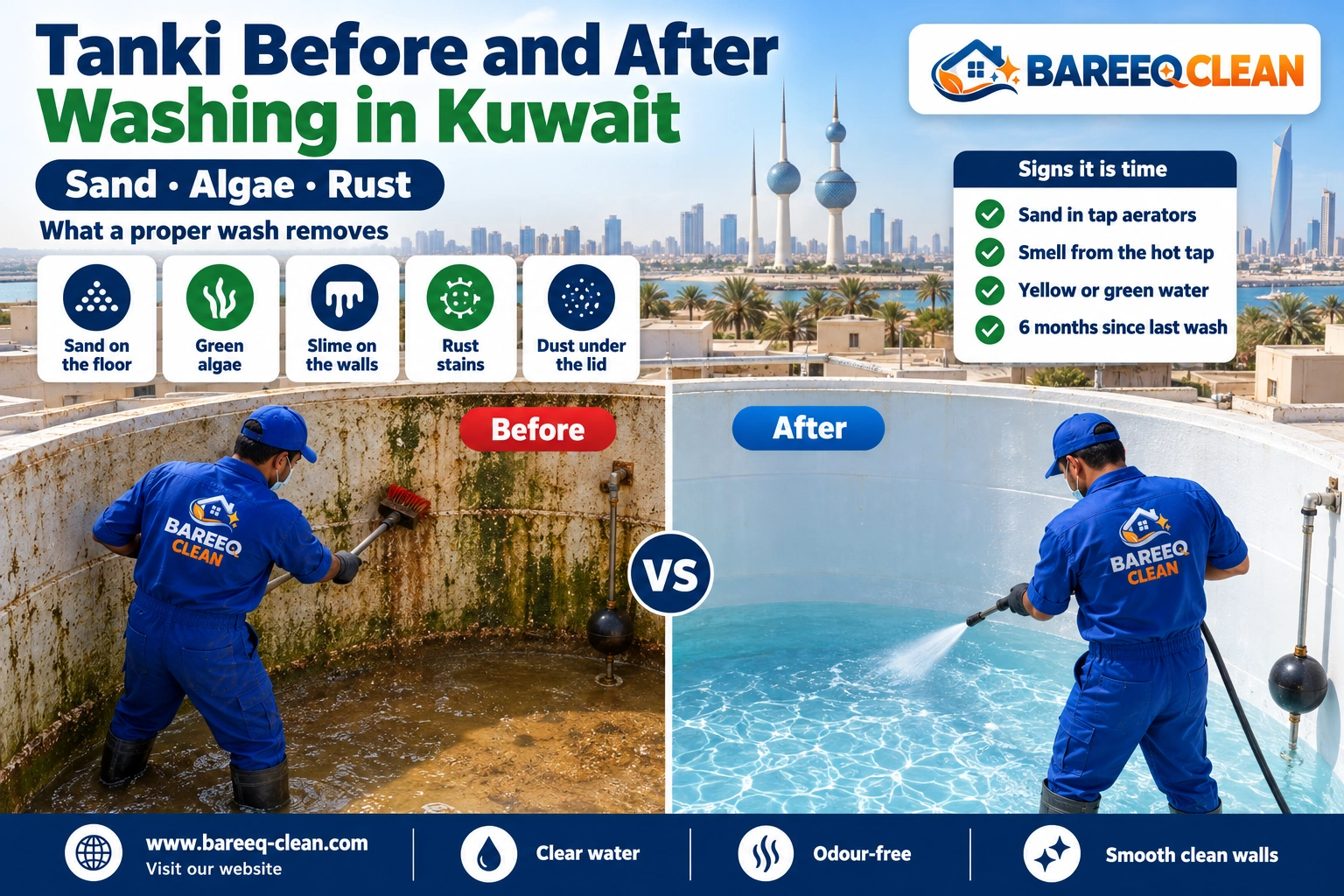
Signs your tanki needs washing
Do not wait for the water to turn visibly cloudy; the tank sends small signals weeks before that:
Tanki water problems: cause and fix
Many people searching for tanki washing are really looking for a fix to a water problem. The table links each problem to its most likely cause and what is done about it:
| Problem | Most likely cause | Fix |
|---|---|---|
| Green water or green patches | Algae in a tank that lets light in | Wash and disinfect, then cover the tank or replace it with an opaque one |
| Yellow or brown water | Rust in a metal tank or iron pipes | Wash and remove rust, replace old pipes |
| Sand in the taps | Sediment from the ground tank | Wash the ground tank then the tanki, fit an inlet filter |
| Musty or rotten-egg smell | Decaying organic matter or a dead insect | Empty fully, wash, disinfect and check the lid |
| Strong chlorine taste | Chlorine added without measuring | Empty, rinse and refill |
| Very hot water in summer | The tank is exposed to the sun | Shade it or fit a tank cooler |
| Weak water pressure | Sediment in pipes or a weak pump | Wash, clean the tap heads and check the pump |
If your problem is hot water rather than dirty water, read water tank cooling in Kuwait; if the water level keeps dropping and the tank leaks, the right guide is water tank repair in Kuwait.
Tanki washing step by step
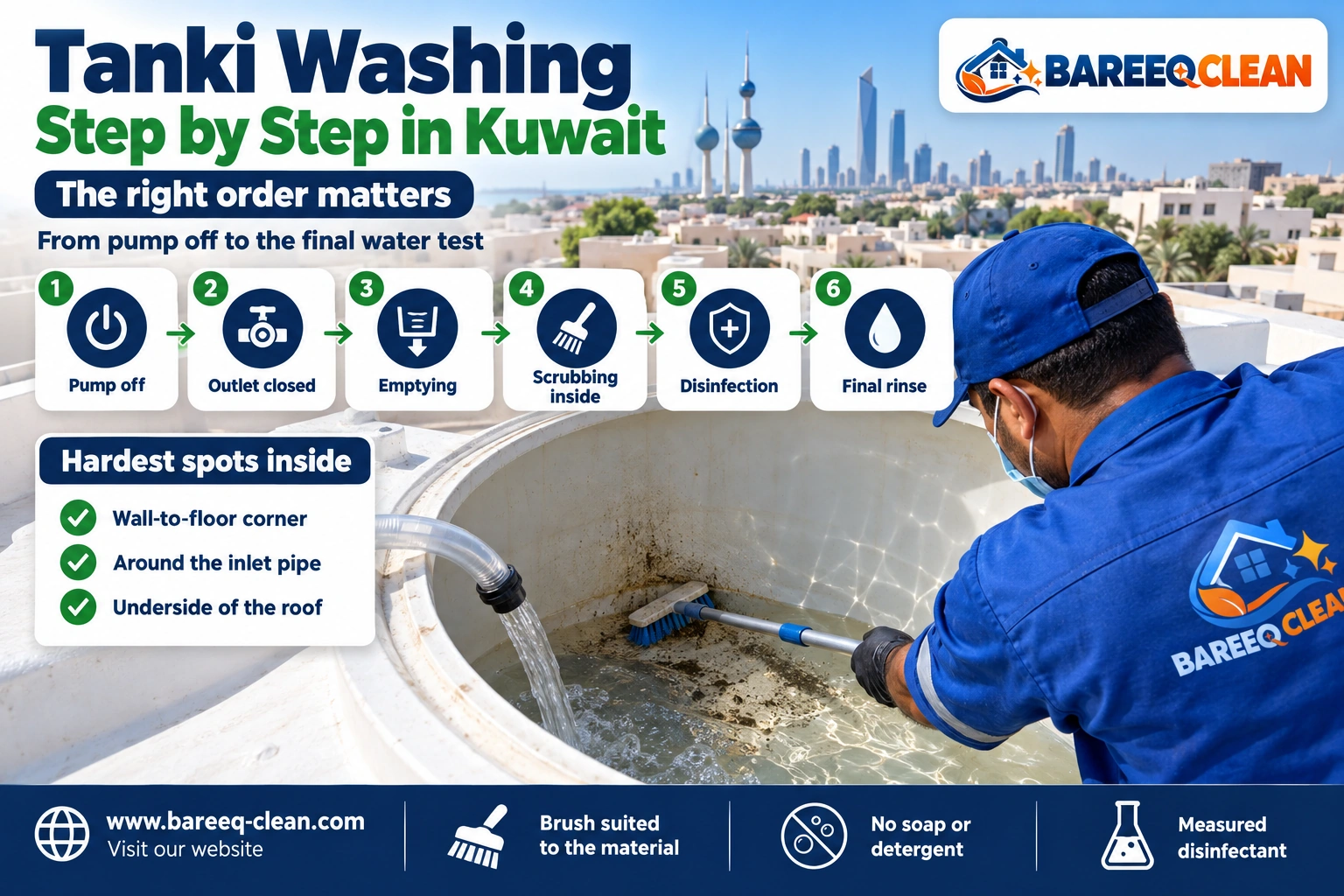
This is how the technician washes the tank on every visit, and the order matters: moving any step earlier or later reduces the benefit of the wash.
- Inspect the tank first: material, capacity, lid and float valve condition, and where the drain valve is.
- Switch off the pump: so no water comes up from the ground tank during the work.
- Close the outlet valve to the house: so sediment does not go down into the pipes.
- Empty the tank: through the drain valve or with a small pump, draining to the roof gully.
- Remove sediment from the floor: by suction or by pushing it towards the drain opening.
- Scrub the inside walls and ceiling: with a brush suited to the tank material and moderate water pressure.
- Clean the lid, float valve and vent: they are part of the tank and touch the water.
- First rinse: draining all the wash water.
- Disinfect: with a drinking-water disinfectant at a measured dose, left for its contact time.
- Final rinse and refill: then switch the pump on and run the taps briefly to refresh the water in the pipes.
Cleaning the tanki from the inside
Three places inside a tank are the hardest: the corner between wall and floor where sand collects, the area around the inlet pipe where slime forms, and the underside of the roof where condensation gathers in summer and black spots grow. The technician goes over these three by hand with a brush even if the rest is pressure-washed.
Hand washing, pressure washing or steam?
The table compares tanki washing methods and what each one suits:
| Method | Suits | Note |
|---|---|---|
| By hand with a brush | Small plastic tanks | Gentle on the surface, takes longer |
| Moderate water pressure | Most home tanks and fibreglass | Fast, with pressure lowered near the inner layer |
| High pressure | Large concrete and metal tanks | Never used on thin plastic |
| Steam | Special cases such as stainless tanks | Does not replace scrubbing, rinsing and disinfection |
Removing rust and limescale from the tanki
In an old metal tank, loose rust is removed with a soft wire brush and the tank is washed well, then checked to see whether the rust is on the surface or has eaten into the wall. White limescale around the float valve and along the waterline is scrubbed off mechanically, and no acid is left inside, because any residue dissolves into drinking water.
Send a photo of the tank from above and where it sits on the roof, with your area, and get the price
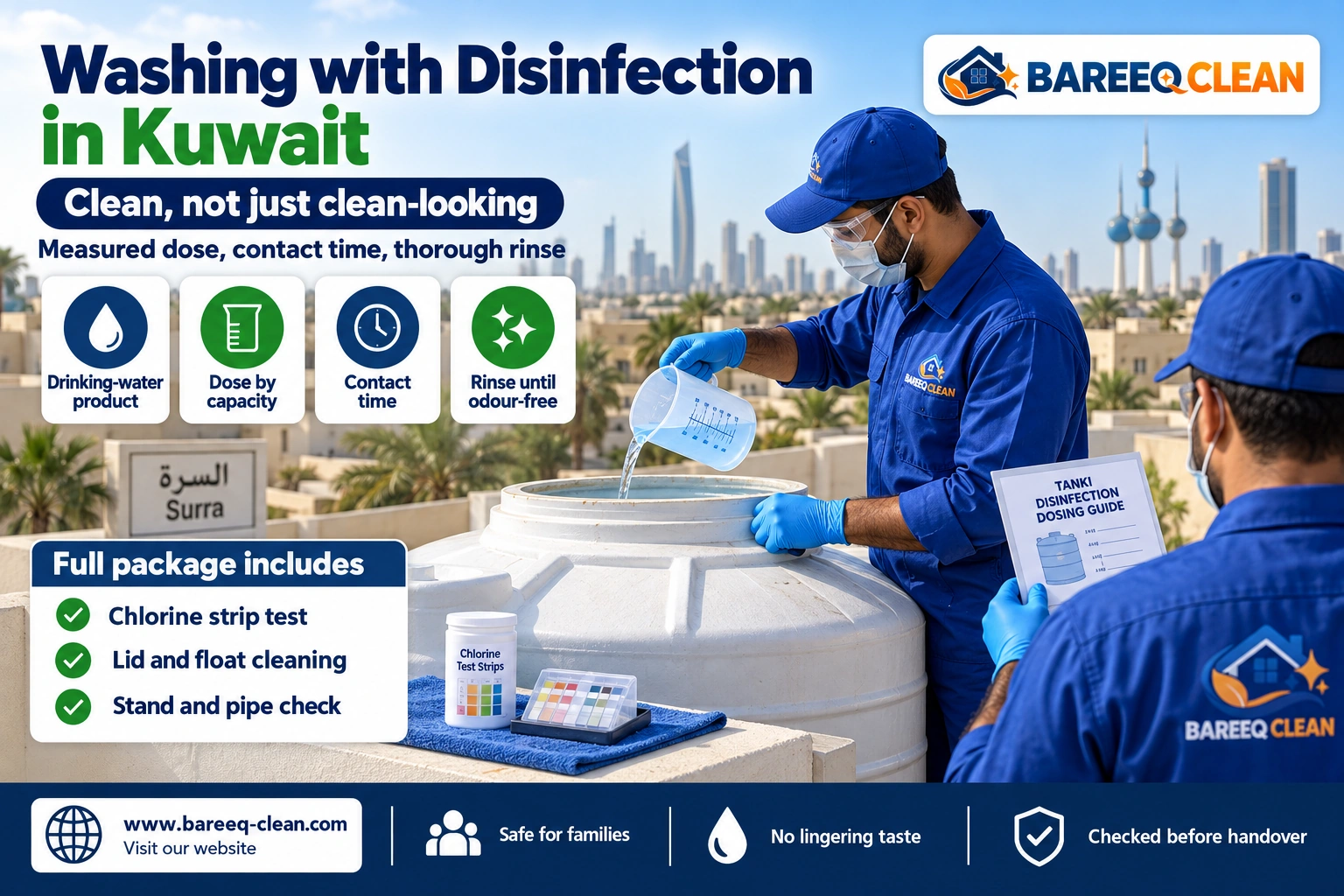
Tank washing with disinfection
Washing the tank with disinfection is the difference between a tank that looks clean and one that is clean. Scrubbing and rinsing remove sand, algae and slime, but invisible bacteria stay on the walls, and disinfection after the wash deals with them. The technician uses a drinking-water disinfectant, calculates the amount from the tank capacity, leaves it for the time it needs, then rinses until the smell has gone.
In the full package, which starts from KWD 14, the tank is disinfected and the water is tested after rinsing with chlorine test strips, the lid, float valve and vent are cleaned, and the stand and outlet pipes of the tank are checked.
Will the water taste of chlorine?
Not if the tank is rinsed properly. You may notice a very faint smell in the first water from the taps, because it was sitting in the pipes, and it clears after running the taps for a minute or two. A strong taste that lingers means someone added chlorine without measuring, and it is fixed by emptying and rinsing.
How to clean a water tanki yourself
If you have a small plastic tank on a roof that is safe to reach, you can wash it yourself between technician visits. Keep these steps and follow them exactly:
- Switch off the pump and close the outlet valve: before anything else.
- Open the drain valve: and let the tank empty to the last drop.
- Scrub with a clean brush kept only for the tank: no soap, detergent or powder.
- Rinse with a hose: until clear water runs from the drain.
- Disinfect with a product made for drinking-water tanks: using the amount on the label for your tank size, no more.
- Rinse again and refill: then run the taps until the water in the pipes is renewed.
Rooftop tank types and how each is washed
The table summarises the rooftop tank types common in Kuwait and how each is washed:
| Tank type | What sets it apart | How it is washed |
|---|---|---|
| Single-layer white plastic | Light and cheap, lets light through | Soft brush and disinfection; covering it is advised |
| Multi-layer plastic | Opaque, blocks light, fewer algae | Soft brush and moderate pressure |
| Fibreglass | Strong, with a smooth inner layer | Medium pressure without scratching the inner layer |
| Stainless steel | Only rusts at the welds | Washed without concentrated chlorine, welds dried |
| Old galvanised iron | Rusts over time | Rust removal then washing; replaced if holed |
If your tank is white and algae keep returning, or iron and rusting, replacing it may cost less than washing it every two months. Available types and sizes are covered in water tanks for sale in Kuwait.
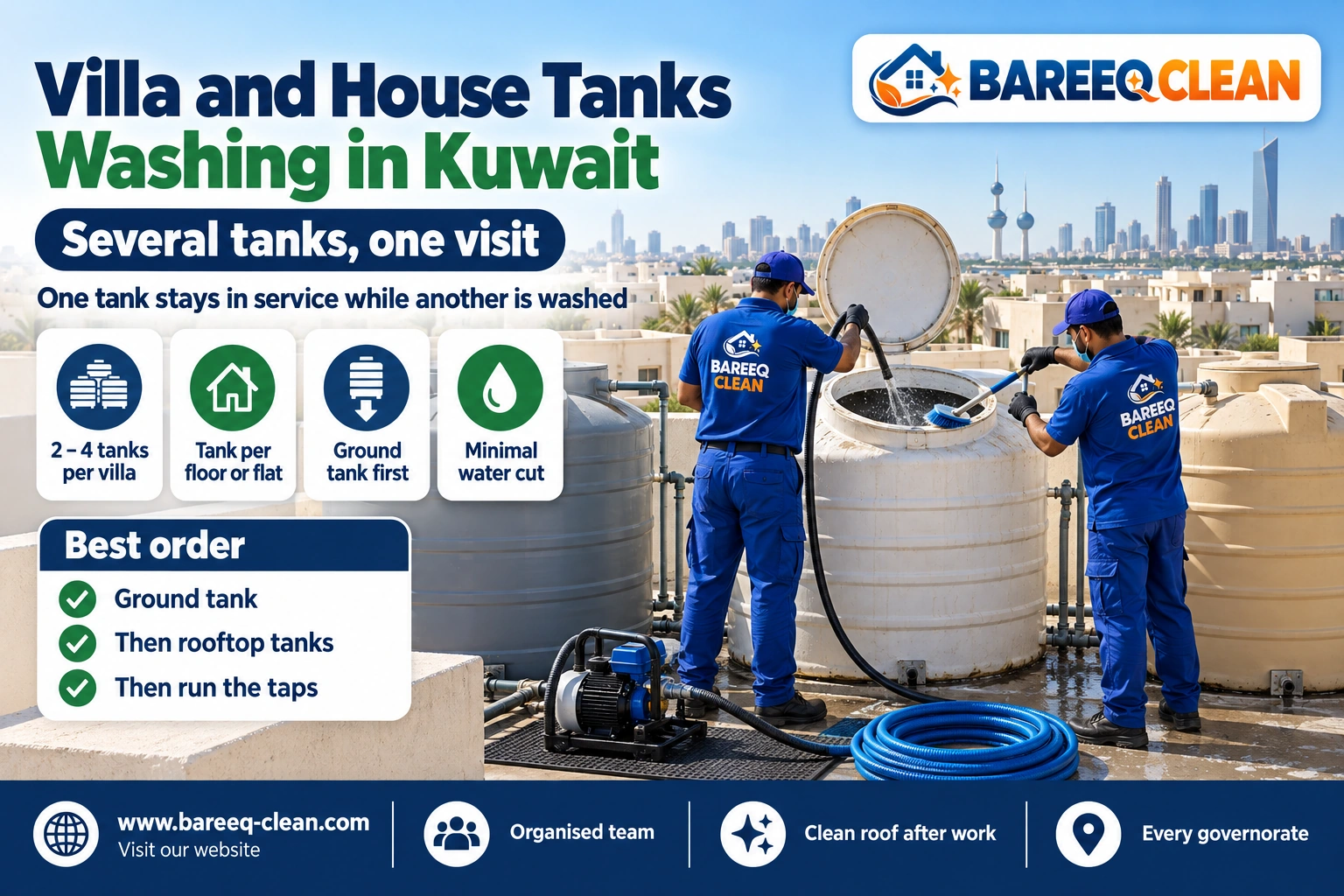
Washing the tanks of a house or villa
Washing the tanki of a Kuwaiti home is rarely about a single tank: villas and multi-storey houses often have two, three or four tanks on the roof, sometimes one per floor or per flat in a rented house. We wash them all in one visit and, where they feed separate pipes, keep one in service while another is washed, so the whole house is not left without water.
Washing tanks of apartment buildings and flats
In an apartment building the rooftop tanks are many and connected to the flats, so the time is agreed with the owner or watchman so residents know when the water will be off. Cleaning large building tanks and periodic contracts are covered in water tank cleaning company in Kuwait.
Washing the tanki and the ground tank in one visit
If your house has a ground tank, washing the tanki alone is half the job: the pump will bring the ground tank sediment back within days. The right order is to wash the ground tank first and then the tanki in the same visit, which also costs less than booking each separately.
How often should a water tanki be washed in Kuwait?
The short answer: at least every 6 months. But a tank washed every 6 months in a small home is not the same as an exposed white tank in a house of ten people. The table shows the right frequency for each case:
| Situation | Right frequency |
|---|---|
| Multi-layer tank in a typical home | Every 6 months |
| White tank that lets light in | Every 3 months, or cover it |
| Busy house or house rented out by flats | Every 3 – 4 months |
| After a dust storm got into the tank | Check, and wash if the water is cloudy |
| House closed during travel | Before using the water again |
| After plumbing work or pipe replacement | Wash and disinfect |
The best time to wash the tanki
Before summer starts, when the water begins to warm and algae multiply, and again after summer ends to clear what has built up. On the day itself, early morning or late afternoon is best: the midday roof in summer is exhausting for the technician and dries the disinfectant on the walls before it has done its job.
Water tanki washing prices in Kuwait
Starting prices in Kuwaiti dinars for rooftop tank washing; you are told the final price before the technician starts:
| Service | From | Time |
|---|---|---|
| Washing a tank up to 1,000 L | KWD 4.5 | About an hour |
| Washing a tank of 1,000 – 3,000 L | KWD 7.5 | 1 – 2 hours |
| Washing a tank over 3,000 L | KWD 11 | 2 hours or more |
| Wash with full disinfection package | KWD 14 | Depends on capacity |
| Extra tank in the same visit | Priced after inspection | — |
What raises or lowers the price of tanki washing?
- Capacity: a larger tank takes longer to empty and rinse.
- Last wash: a tank untouched for years holds far more sediment.
- Location: a tank on a high roof without stairs or behind obstacles needs extra set-up.
- Number: each extra tank in the same visit costs less than a separate visit.
- Full disinfection: the full package includes the chlorine test and cleaning of the lid and float valve.
The cheapest tanki washing in Kuwait
Our cheapest tanki washing in Kuwait starts from KWD 4.5 for a home tank up to 1,000 litres. What we make sure of is that the saving is in the price, not in the steps: rinsing, disinfection and the water check are part of every visit.
What to prepare before the technician arrives
- Fill a few water bottles: for drinking and washing during the job.
- Use less water before the visit: so the tank level is low and emptying is quicker.
- Clear the way to the roof: and move anything blocking access to the tank.
- Know where the pump and its switch are: and tell the technician if it has a timer.
- Tell us about any problem you noticed: smell, colour or sand, so we can check the cause.
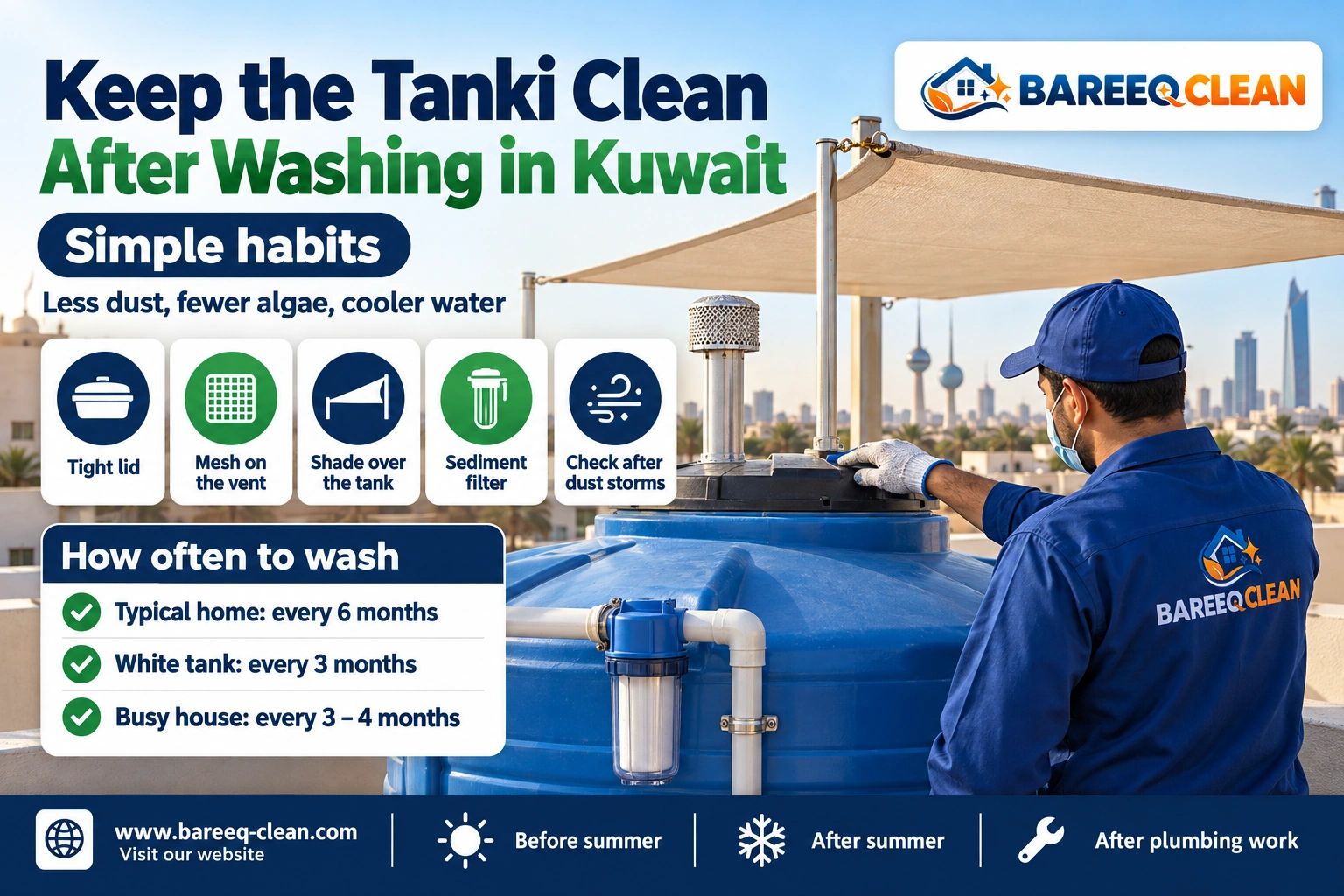
How to keep the tanki clean after washing
- Keep the lid tight: and replace it if the sun has cracked it.
- Fit a fine mesh on the vent pipe: to keep out insects and dust.
- Shade the tank: a simple shade cuts heat and algae.
- Clean the ground tank on schedule: it is the source of the tanki’s sediment.
- Fit a sediment filter after the pump: and change its cartridges after each wash; see central water filters in Kuwait.
- Check the tank after every dust storm: lift the lid and look at the water surface.
Common tanki washing mistakes
| Mistake | Result |
|---|---|
| Washing the tank with soap or dish liquid | Foam and a taste that lasts for days |
| Adding laundry bleach without measuring | Strong smell and skin irritation |
| Leaving the pump on during washing | Dirty water flows in as you wash |
| Opening the house valve while emptying | Sediment goes into the pipes and water heater |
| Washing the tanki and ignoring the ground tank | Sand is back within days |
| Forgetting the lid and vent | Dust and insects return |
Related tank services
- Water tank cleaning company in Kuwait: ground tanks, buildings, disinfection and sealing.
- Water tank repair: welding, leaks, float valves, removal and installation.
- Tank cooling: cooler water in summer.
- Water tanks for sale: replacing an old tank.
- Central filters and pumps: cleaner water and stronger pressure.
Tanki washing in every area of Kuwait
We wash tanks across all six governorates daily from 7 am to 11 pm. The main areas we reach:
| Governorate | Areas where we wash tanks |
|---|---|
| Capital | Kaifan, Rawda, Adailiya, Khaldiya, Qadsiya, Yarmouk, Qurtuba, Surra, Dasma, Shuwaikh, Nuzha, Faiha, Doha |
| Hawalli | Salmiya, Hawalli, Jabriya, Rumaithiya, Bayan, Mishref, Salwa, Shaab, Bidaa, Zahra, Hitteen, Salam |
| Farwaniya | Farwaniya, Khaitan, Ardiya, Andalous, Rabiya, Rehab, Ferdous, Omariya, Ishbiliya, Jleeb Al-Shuyoukh |
| Ahmadi | Fahaheel, Mangaf, Fintas, Mahboula, Abu Halifa, Riqqa, Sabahiya, Hadiya, Egaila, Wafra, Khairan |
| Jahra | Jahra, Saad Al-Abdullah, Qasr, Waha, Naeem, Oyoun, Taima, Naseem, Qairawan, Abdali |
| Mubarak Al-Kabeer | Sabah Al-Salem, Qurain, Adan, Qusour, Messila, Abu Fatira, Fnaitees, Sabhan |
Tanki washing in Hawalli
Tanki washing in Hawalli, Salmiya and Jabriya is available daily, where shared tanks on the roofs of older buildings are common.
Tanki washing in Farwaniya
Tanki washing in Farwaniya, Khaitan, Andalous and Rabiya covers houses rented out by flats with several tanks.
Tanki washing in Jahra
Tanki washing in Jahra, Saad Al-Abdullah, Waha and Qasr, where houses are spacious and dust is heavier in storm seasons.
Tanki washing in Ahmadi
Tanki washing in Ahmadi, Fahaheel, Mangaf, Fintas and Mahboula, plus the chalets of Khairan and Wafra before summer.
Service guarantee
6 months on tanki washing and disinfection: if the water turns cloudy or sediment appears because of the work within that period, we wash again free of charge. Details are on the service guarantee page.
Write how many tanks you have, the capacity of each, your area and a time that suits you
Article tags
Tanki washing: tanki washing Kuwait · water tanki washing · water tank washing Kuwait · home water tank washing · rooftop tank washing Kuwait · overhead tank cleaning Kuwait · tank washing with disinfection · water tank cleaning near me · tank cleaner Kuwait
Tanki cleaning: clean water tanki · clean the tanki from inside · tank rust removal · how to clean a water tank · tanki algae removal · green water in tank
Areas: tanki washing Hawalli · tanki washing Salmiya · tanki washing Farwaniya · tanki washing Jahra · tanki washing Ahmadi · tanki washing Mubarak Al-Kabeer · tanki washing Kuwait City
Frequently asked questions about water tanki washing in Kuwait
How much does water tanki washing cost in Kuwait?
A tank up to 1,000 litres starts from KWD 4.5, 1,000 to 3,000 litres from KWD 7.5, over 3,000 litres from KWD 11, and the full wash-with-disinfection package from KWD 14.
How often should I wash my home tanki?
At least every 6 months, ideally before and after summer, and every 3 months if the tank is white plastic or the house has many occupants.
How long does tanki washing take?
About an hour for a home tank up to 1,000 litres and two hours for a large or heavily silted one; water returns to the house right after rinsing and testing.
Is the water cut off during washing?
Yes, only for the washing time, so fill a few bottles for use. If the house has more than one tank, one can stay in service while the other is washed.
Should I empty the tanki before the technician arrives?
No, the technician empties it, but using less water for a few hours before the visit keeps the level low and shortens the job.
Will the water taste of chlorine after disinfection?
No. The tank is rinsed after disinfection until the smell is gone; you may notice a very faint trace in the first water from the pipes, which clears within hours.
Can I wash the tanki myself?
Yes, a small plastic tank on a safe roof, following the steps in this article and without soap or detergents. Leave ground tanks and large tanks to a technician.
Why is the water sandy after the tanki was washed?
Usually because the ground tank was not cleaned, so the pump draws its sediment into the clean rooftop tank. Wash the ground tank first, then the tanki.
Why is my tank water green?
The tank lets light through, so algae grow. Wash and disinfect it, then cover it or replace it with an opaque multi-layer tank.
Do you wash tanks for houses, villas and apartment buildings?
Yes, for houses, villas, flats and buildings, and several tanks in the same visit.
Do you remove rust from tanks?
Yes, in metal tanks, by removing loose rust and then washing; if rust has holed the wall we recommend replacing the tank.
Do you clean petrol tanks?
No. Our service is for water tanks only; cleaning fuel tanks is a different job handled by specialist firms.
Is tanki washing guaranteed?
Yes, for 6 months: if the water turns cloudy or sediment appears because of the work, we wash again.
Which areas of Kuwait do you cover?
All six governorates: Capital, Hawalli, Farwaniya, Ahmadi, Jahra and Mubarak Al-Kabeer, daily from 7 am to 11 pm.